
Quick version
What is thyroid cancer?
Thyroid cancer is a condition that occurs and affects the cells of the thyroid gland. The thyroid is a small hormone-producing gland located at the front of the neck and has an important function in regulating the body's metabolism. The disease is quite uncommon and there are several different forms of thyroid cancer that differ in terms of development, treatment and, not least, prognosis.
A lump or swelling in the neck is one of the most common signs that leads to the thyroid being examined. However, discovering a lump, swelling or cyst does not mean that you have cancer. Nodules and other changes in the thyroid gland are common and most are benign. At the same time, it is not possible to determine the cause simply by feeling a lump, which is why a new or growing change should be assessed within the healthcare system. A common examination method is thyroid ultrasound or MRI or CT.
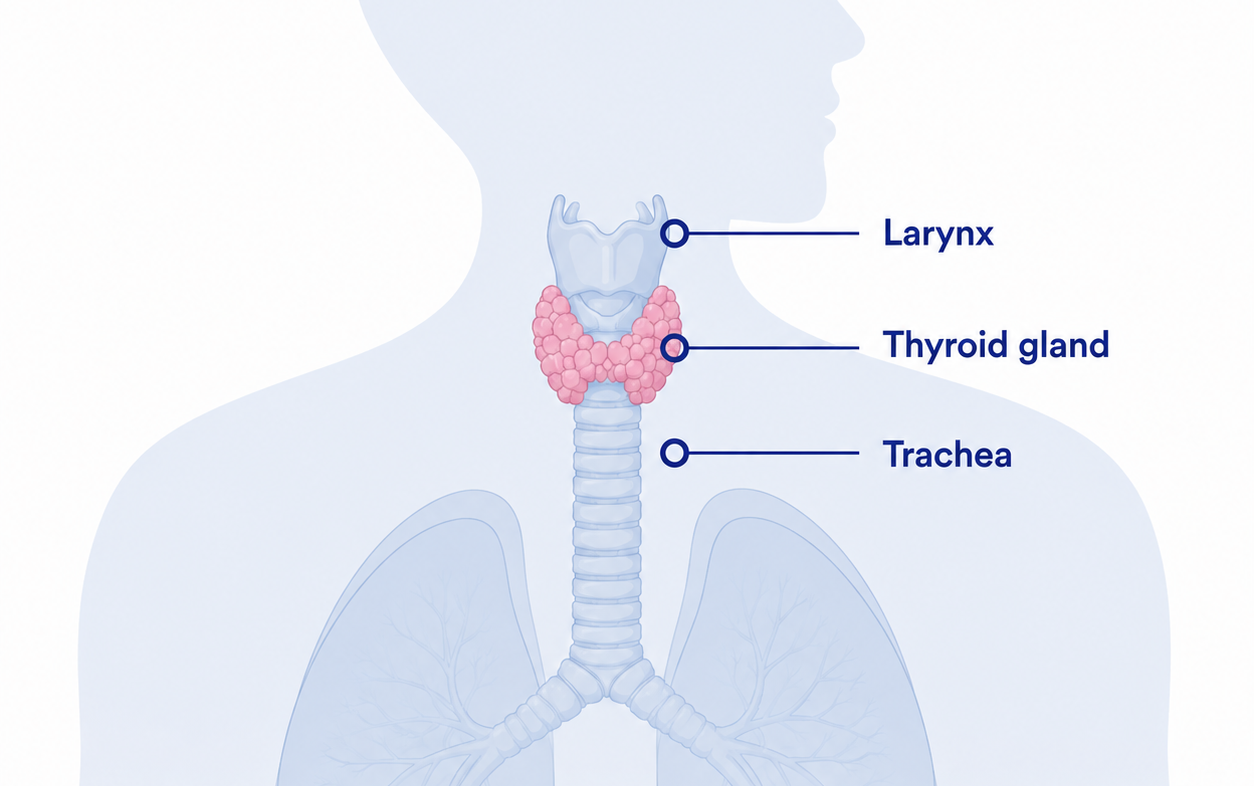
The most common forms are papillary and follicular thyroid cancer. They often develop slowly and generally have a very good prognosis. There are also more unusual forms, such as medullary and anaplastic thyroid cancer, which differ from the more common forms and may require different treatment. If thyroid cancer is suspected, a clinical examination is usually performed together with an ultrasound of the thyroid. If a nodule has characteristics that need to be examined more closely, a cell sample can be taken with a thin needle. Blood tests are also used to assess thyroid function, but standard thyroid tests cannot in themselves determine whether a nodule is cancer.
Provided that thyroid cancer is diagnosed, treatment depends on the type of cancer, the size of the tumor, and whether the disease has spread. Surgery is a central treatment for many forms of thyroid cancer and can sometimes be supplemented with, for example, radioactive iodine. For the most common types, the chances of successful treatment are very good.
Symptoms of thyroid cancer
Thyroid cancer may cause few or no symptoms in the early stages. In many people, the disease is discovered after the person themselves, a doctor or dentist has noticed a lump or swelling in the neck. The most common symptom is a new lump in the thyroid gland, often on the front of the neck. The lump is usually not painful. A lump in the thyroid gland is not cancer in most cases. Benign lumps, cysts and goiters are significantly more common. It is primarily changes that are new, growing or combined with other symptoms that need to be assessed more closely.
Symptoms that may occur with thyroid cancer include:
- A new lump or swelling in the neck.
- A lump that increases in size over time.
- Enlarged or hard lymph nodes in the neck.
- Hoarseness or a change in voice that does not go away.
- Pressure or discomfort in the throat.
- Difficulty or pain when swallowing.
- A feeling that something is in the way in the throat.
- In more rare cases, difficulty breathing.
Hoarseness or difficulty swallowing can occur if a tumor affects structures near the thyroid gland or at the junction of the windpipe and esophagus. Note that such symptoms have many other benign and much more common causes than cancer.
Thyroid cancer also does not always affect the production of thyroid hormone. This means that you can have normal values for, for example, TSH and T4 despite there being a change in the thyroid gland. Symptoms such as fatigue, weight changes, palpitations or feeling cold are therefore not typical signs of thyroid cancer per se, but are more often linked to altered thyroid function for other reasons. If you discover a new lump on your neck or notice that an existing lump is growing, you should contact your healthcare provider for an assessment. This does not mean that the symptoms are due to cancer, but it is important to find out the cause.
A lump in the thyroid gland is usually not cancer
Discovering a lump in or around the thyroid gland can be worrying, but the vast majority of lumps are not malignant. A lump may, for example, be due to a benign thyroid nodule, cyst or goiter. However, it is not possible to determine the cause simply by feeling the lump. A new or growing lump on the neck should therefore be assessed by a healthcare professional.
Different types of thyroid cancer
Thyroid cancer can be divided into several different types depending on which cells in the thyroid the cancer has developed from and what the tumor cells look like. The different types of cancer differ in terms of how fast they grow, how they tend to spread and which treatment is most appropriate. The four main conditions are papillary, follicular, medullary and anaplastic thyroid cancer. Papillary and follicular cancer are so-called differentiated thyroid cancers. They still resemble normal thyroid cells in many respects and can often retain the ability to absorb iodine, which is important for treatment. Medullary and anaplastic thyroid cancer have a different biological behavior and are treated in some ways differently.
Papillary thyroid cancer
Papillary thyroid cancer is the most common form and arises in the thyroid follicular cells that normally participate in the production of thyroid hormone. The tumor usually grows slowly and generally has a good prognosis. However, papillary cancer can spread to nearby lymph nodes in the neck. However, the fact that cancer cells are found in lymph nodes does not necessarily mean the same deterioration in prognosis as with many other cancers, especially in younger people. Treatment often consists of surgery where parts of or the entire thyroid gland are removed. In some cases, the treatment is supplemented with radioactive iodine.
Follicular thyroid cancer
Follicular thyroid cancer also develops from the thyroid follicular cells and, like papillary cancer, belongs to the differentiated cancers. It is less common than papillary thyroid cancer and in many cases also has a good prognosis. An important difference is how the disease tends to spread. Follicular cancer is less likely to spread to lymph nodes and can instead grow into blood vessels. If the disease spreads outside the thyroid gland, metastases can occur in the lungs or bones. Surgery is the main treatment, and radioactive iodine may be used in some cases because the tumor cells often have the ability to take up iodine.
Medullary thyroid cancer
Medullary thyroid cancer differs from the papillary and follicular forms in that it develops from the thyroid's C cells, also called parafollicular cells. These cells produce the hormone calcitonin, which is involved in the body's regulation of calcium. Elevated levels of calcitonin in the blood can therefore be an important marker in the diagnosis and follow-up of medullary thyroid cancer. The tumor can spread to lymph nodes and later to other organs.
Most cases occur without a known hereditary cause, but some are linked to hereditary changes in the RET gene and may be part of the hereditary syndrome MEN2. Therefore, genetic testing may be relevant when medullary thyroid cancer is diagnosed. Treatment mainly consists of surgery. Unlike papillary and follicular cancer, radioactive iodine has no effect on the medullary form because C-cells do not take up iodine in the same way.
Anaplastic thyroid cancer
Anaplastic thyroid cancer is a very rare but aggressive form of thyroid cancer. The tumor cells are severely altered and have lost many of the properties of normal thyroid cells. The disease occurs primarily in older people and can grow rapidly. Because the thyroid gland is located close to the trachea, esophagus and nerves in the neck, a rapidly growing tumor can cause symptoms such as a clearly increasing lump, hoarseness, difficulty swallowing and/or breathing problems. Anaplastic thyroid cancer can also grow into surrounding tissues early and spread to other parts of the body. Treatment therefore needs to be planned individually and may consist of a combination of surgery, radiation therapy and drug therapy. The prognosis for anaplastic thyroid cancer is worse than for the more common differentiated forms of thyroid cancer.
What causes thyroid cancer?
In most cases, no single cause can be identified for the development of thyroid cancer. Cancer occurs when genetic changes cause cells to grow and divide uncontrollably. Known factors that may increase the risk include previous exposure to ionizing radiation to the neck area, especially during childhood. In some rare forms, inherited genetic changes may play a role.
How is thyroid cancer detected and investigated?
In the case of a lump or other suspicious change in the neck, the investigation usually begins with a doctor examining the neck and thyroid gland. Based on the doctor's decision, the investigation may further include:
- Ultrasound of the thyroid gland.
- Fine-needle aspiration biopsy.
- Blood tests to check thyroid function.
- Additional imaging if necessary.
Ultrasound is a key examination because the doctor can assess the size, structure and other characteristics of a lump. If the change needs to be investigated further, a cell sample can be taken with a thin needle and analyzed under a microscope.
Can regular thyroid tests detect thyroid cancer?
Regular thyroid tests such as TSH, T4 and T3 are used to assess how the thyroid gland is functioning, but normal thyroid values do not rule out thyroid cancer. Blood tests can therefore be part of the investigation, but if a tumor is suspected, ultrasound and, if necessary, cell tests are important to assess the change.
How common is thyroid cancer?
Thyroid cancer is a relatively uncommon form of cancer. In Sweden, approximately 600 people are diagnosed each year, which means that the disease is significantly less common than many other forms of cancer. At the same time, benign nodules and other changes in the thyroid gland are very common, and only a small proportion of all nodules turn out to be cancer. The disease is about twice as common in women as in men. It can occur at any age, but the median age at diagnosis is around 55 years. Unlike many other cancers, it is therefore not uncommon for thyroid cancer to be diagnosed as early as the age of 40–60.
The number of people diagnosed with thyroid cancer has increased in recent decades. Part of the increase is thought to be because ultrasound and other imaging tests are detecting small tumors more often than before, even when they have not caused any obvious symptoms. The prognosis is generally very good, especially for the most common forms of thyroid cancer, papillary and follicular. More than nine out of ten people with thyroid cancer live at least five years after diagnosis, although the prognosis varies depending on factors such as the type of tumor, age, stage of the disease and whether the cancer has spread.
How is thyroid cancer treated?
Surgery is the most common treatment and involves removing all or part of the thyroid gland. For some patients, treatment with radioactive iodine is then used to eliminate remaining thyroid cells. After the entire thyroid gland has been surgically removed, the patient needs treatment with thyroid hormone, usually levothyroxine, to replace the hormones that the body can no longer produce on its own.
Seek medical attention if you suspect changes in the thyroid gland
Always contact your healthcare provider if you discover a new lump in your neck or if an existing lump begins to grow. You should also seek medical attention if you have prolonged unexplained hoarseness, persistent pressure in your throat, difficulty swallowing, or enlarged lymph nodes in your neck. Such symptoms are much more often caused by other conditions, but it is important to have a doctor assess the cause.