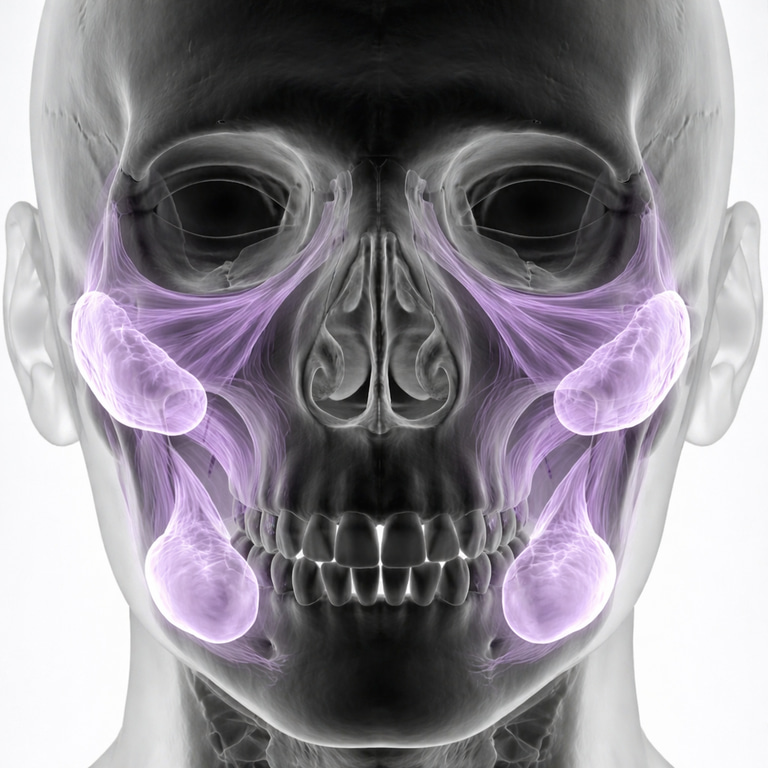
Facial MRI – Examination of soft tissues and deep structures
Facial MRI is a magnetic resonance imaging examination that provides detailed images of the face's soft tissues and deeper anatomical structures. The examination may cover, among other things, muscles, salivary glands, soft tissues surrounding the jaws, and other tissues in the facial region. Depending on the clinical question, nerve structures and other specific areas may also be assessed.
Unlike a sinus MRI, which primarily targets the sinuses and nasal cavity, a facial MRI focuses mainly on soft tissues and structures outside the sinus system itself. As is standard for MRI examinations, the procedure is performed entirely without X-ray radiation.
Facial MRI is used for conditions such as unexplained swelling, lumps, persistent facial pain, suspected soft-tissue abnormalities, or when mapping changes in areas like the salivary glands and deeper tissues. MRI offers high contrast resolution for soft tissues, providing valuable information in cases of inflammation, cystic changes, or suspected tumors. Depending on the specific clinical question, the examination may need to be tailored; for instance, issues involving the temporomandibular joint (jaw joint) or specific cranial nerves might require a more targeted MRI protocol. In some cases, a contrast agent may also be required to provide a more detailed assessment.
MRI may also be relevant for persistent issues following aesthetic injection treatments, such as fillers. In some instances, the examination can help identify soft-tissue changes, inflammation, lump formation, or suspected migration of the injected material. The clarity with which different filler products can be visualized varies depending on the material, location, and imaging protocol.
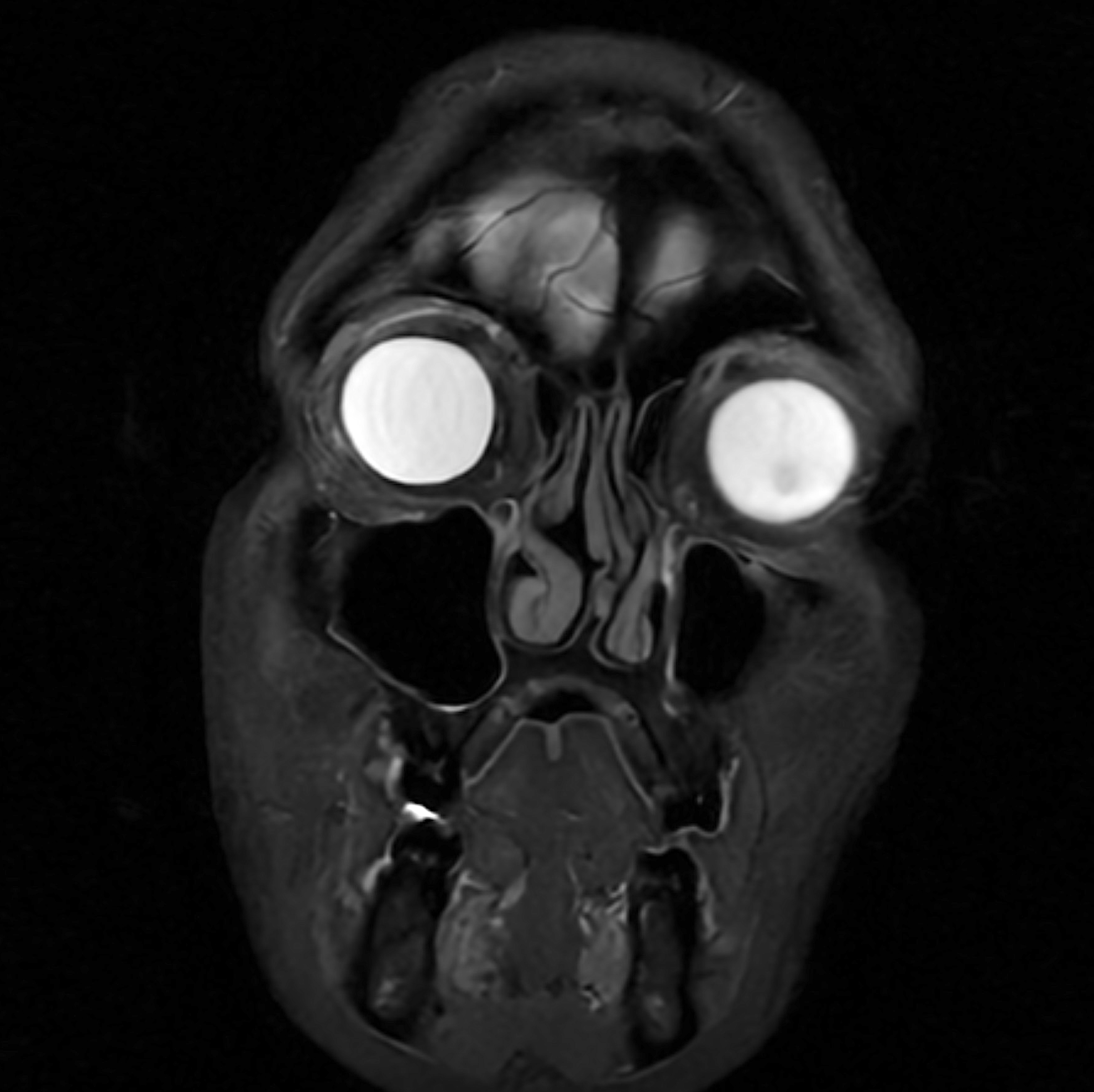
Coronal MRI scan of the face showing, among other structures, the orbits, sinuses, nasal cavity, and surrounding soft tissues. The imaging plane provides a frontal view of the facial structures.
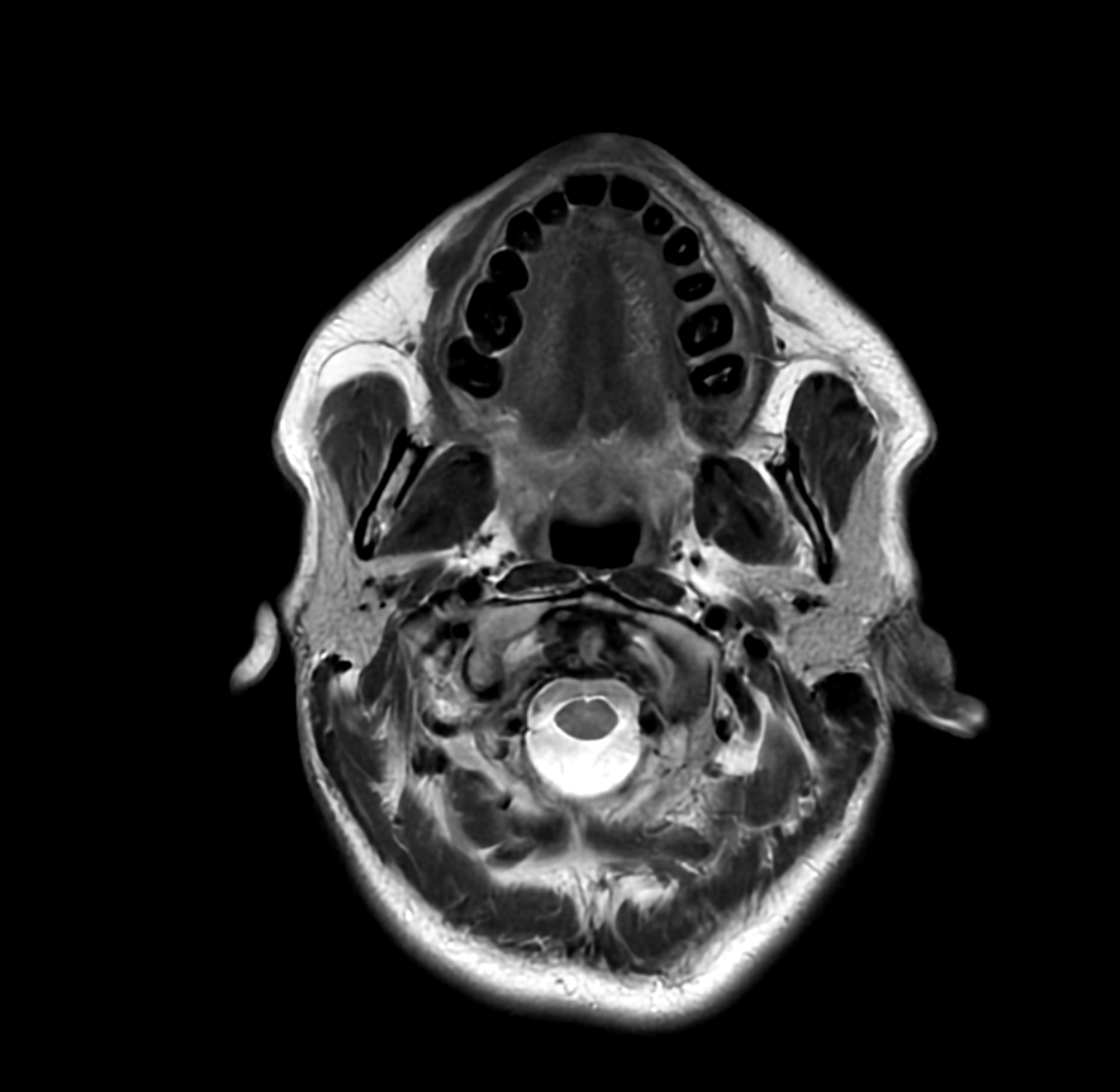
Axial MRI scan through the lower face and upper neck. This examination visualizes, among other things, the oral cavity, jaw area, and pharynx, as well as surrounding muscles and soft tissues.
When might an MRI of the face be appropriate?
The examination may be indicated in cases of symptoms or findings requiring a detailed assessment of the facial soft tissues and deeper anatomical structures.
- Unexplained or persistent facial swelling or a lump.
- Suspected abnormality in a salivary gland, soft tissue, or deep facial tissue.
- Prolonged or unexplained facial pain.
- Suspected inflammation or infection in the deeper facial tissues.
- Follow-up of a previously known abnormality or post-surgical assessment.
- Investigation of persistent issues following aesthetic injection treatments.
- Other clinical questions requiring detailed imaging of facial soft tissues.
What can an MRI of the face reveal?
- Soft tissue abnormalities in muscles, adipose tissue, and connective tissue.
- Salivary glands (parotid, submandibular) and potential tumors or inflammation.
- Nerve structures and signs of nerve involvement.
- Temporomandibular joint (TMJ) discs, joint capsule, and surrounding structures.
- Cysts, vascular malformations, or deep-seated infections.
- The relationship between abnormalities and adjacent structures prior to surgery.
The difference between MRI Face and MRI Sinus
MR Sinus focuses primarily on the sinuses, mucous membranes and nasal cavity in cases such as chronic sinusitis or polyps. MRI Face, on the other hand, focuses on soft tissue, salivary glands, nerve structures, temporomandibular joint and deeper tissues in the facial region. The choice of examination depends on your symptoms and the medical question - our doctors will help you determine the right method.
Dialogue with a doctor is always included
When booking an MRI Face, a consultation with one of our doctors is always included. We ensure a clear question, review your medical history and assess whether the examination is medically appropriate. In some cases, other imaging diagnostics may be recommended depending on the symptoms and clinical picture. If, for example, your symptoms instead indicate a sinus problem, we recommend MRI Sinus.
This is an important part of our medical quality assurance and helps ensure that you receive an accurate and relevant examination.
Book an MRI Face - safe and radiation-free examination
The examination is painless and usually takes 30–40 minutes. You lie comfortably in the magnetic resonance imaging camera while high-resolution images are taken of the area in question. No X-rays are used. The images are reviewed by a radiology specialist and you will receive a written medical report within a few days.
MRI cannot be performed if you have certain metal implants, pacemakers or other contraindications. A safety form is always filled out before the examination. Pregnant women before week 12 are only examined for special medical reasons. In cases of severely impaired kidney function (GFR < 30), contrast agents are almost always avoided.< /p>