Quick version
Facial anatomy and structure
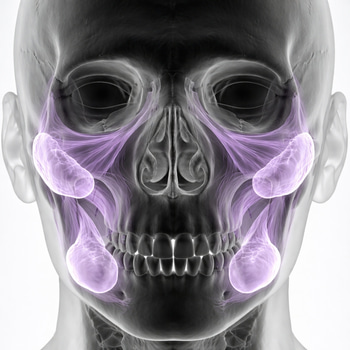
The face extends from the forehead and temples down towards the jaw and includes both superficial soft tissues and deeper structures. Beneath the skin are subcutaneous fat, connective tissue and several muscles. Deeper structures include the facial skeleton, temporomandibular joints, nerves, blood vessels and parts of the salivary glands.
The paranasal sinuses, also known as the sinuses, are air-filled cavities within the bones of the skull and are located close to the face, but they are not part of the facial soft tissues. Symptoms in the facial region can therefore arise from several different structures, including the skin and subcutaneous tissue, muscles, nerves, salivary glands, temporomandibular joints, teeth, jaws or sinuses.
Important structures of the face
- Facial muscles: muscles that make it possible to smile, frown and shape the lips, among other facial expressions. These muscles are mainly controlled by the facial nerve.
- Trigeminal nerve: the fifth cranial nerve, which mainly carries sensory information from large parts of the face and also contains motor nerve fibres supplying the muscles used for chewing.
- Facial nerve: The seventh cranial nerve, which controls most of the muscles responsible for facial expression and also has other functions, including those related to taste and certain glands.
- Salivary glands: The major salivary glands are the parotid glands, submandibular glands and sublingual glands. They all produce saliva, which helps moisten the mouth and contributes to the breakdown of food.
- Temporomandibular joint: The temporomandibular joint, or TMJ, connects the lower jaw to the temporal bone and enables movements used for activities such as chewing and speaking.
- Blood vessels and lymphatic vessels: These form an extensive network that supplies the tissues of the face with blood and transports lymphatic fluid to lymph nodes in areas including the head and neck.
Functions of the face
The face has several functions that are important for both communication and other basic bodily functions. The facial muscles make it possible to express emotions, while the trigeminal nerve conveys sensations such as touch, temperature and pain from the face. The chewing muscles and temporomandibular joints allow the lower jaw to move during chewing and speech.
The salivary glands produce saliva, which moistens the lining of the mouth, facilitates swallowing and helps protect the teeth and oral cavity. The structures of the face also surround the eyes, nose and mouth, helping to protect and support several of the head's sensory organs and openings.
Common problems and changes in the facial region
Because the face consists of many different types of tissue, facial symptoms can have a wide range of causes. A lump or swelling may, for example, arise from the skin, subcutaneous tissue, a salivary gland, a lymph node or another soft tissue. Pain may originate from the temporomandibular joint, muscles, teeth, sinuses or nerves.
- Salivary gland inflammation: Inflammation of a salivary gland can cause pain and swelling, among other symptoms. It may sometimes be associated with an infection or a blockage in a salivary duct.
- Salivary gland tumours: Both benign and malignant tumours can develop in the salivary glands. A newly developed or persistent lump should be medically assessed.
- Trigeminal neuralgia: A nerve pain condition that typically causes brief attacks of intense, often electric shock-like or stabbing pain on one side of the face.
- Temporomandibular joint problems: Problems affecting the jaw joint and surrounding chewing muscles can cause pain, tenderness, clicking sounds or difficulty opening the mouth normally.
- Cysts and soft tissue changes: Various benign changes can develop in the skin, subcutaneous tissue and other soft tissues.
- Infection and abscess: Infections originating from, for example, the skin, teeth or deeper tissues can cause pain and swelling and may sometimes lead to a collection of pus, known as an abscess.
Symptoms that may arise from the face
The symptoms that occur depend on which structure is affected. Similar symptoms can occur in several different conditions, so the symptoms alone are usually not sufficient to determine the underlying cause.
- swelling on one or both sides of the face
- a lump or area of firmness in the soft tissues
- pain or tenderness
- numbness, tingling or altered sensation
- brief attacks of intense nerve pain
- pain or stiffness when chewing or opening the mouth
- reduced facial movement or weakness in parts of the face
- persistent or recurrent swelling
New-onset facial weakness, particularly if it develops suddenly together with symptoms such as weakness in an arm or leg or speech difficulties, should be assessed urgently because such symptoms can occur with stroke.
How the face can be examined
The most appropriate assessment depends on the symptoms and which part of the face is suspected to be affected. A clinical examination may include inspection and palpation of the facial soft tissues, assessment of sensation and motor function, and examination of jaw movements, the oral cavity and the salivary glands. In cases of facial pain, a dental examination may also be relevant because problems affecting the teeth and jaws can cause pain in the same areas.
Ultrasound is often used for superficial abnormalities and can provide information about, for example, the salivary glands, lymph nodes, cysts and other soft tissue changes. Ultrasound can also be used to guide sampling from certain abnormalities.
CT provides detailed cross-sectional images and is particularly useful when the facial skeleton needs to be assessed, for example after trauma or when a fracture is suspected. CT may also be used in certain infections and other changes in the facial region.
MRI of the face provides detailed images of soft tissues and may be relevant for certain changes affecting, for example, the salivary glands, deeper soft tissues and nerve structures. MRI and CT can complement each other depending on the clinical question: MRI provides particularly detailed information about soft tissues, while CT often provides better detail of bony structures.
For certain lumps or other tissue changes, a tissue sample or cytology sample may be needed to determine the nature of the abnormality. Diagnostic imaging mainly shows anatomy and structural changes and cannot on its own determine the cause of every type of symptom.