Health examinations
At Testmottagningen.se you can order several different health examinations to get a clearer picture of your health. Our examinations may be relevant if you want to investigate symptoms, follow up on previous complaints or act preventively. You can order MRI examinations, ultrasound, long-term ECG and full-body examinations with medical assessment, among other things.
The examinations are performed at our diagnostic partners and reviewed by specialist doctors in the relevant field. The doctors at the test clinic help with medical assessment, referral management and guidance on the next steps if the examination shows findings that need to be followed up.
Through our digital approach you can easily order your examination online, receive a referral after medical assessment and see your results digitally. The goal is to make qualified diagnostics more accessible, safe and convenient – without unnecessary waiting time.
Magnetic Resonance Imaging
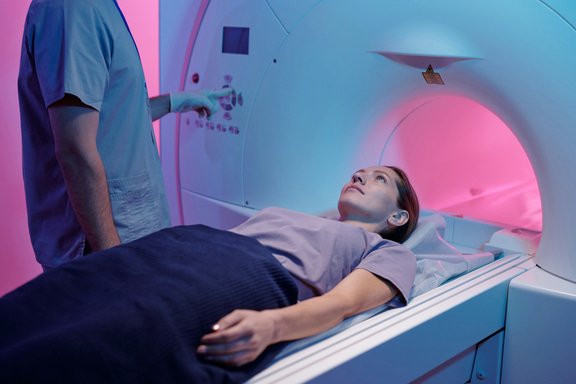
An MRI scan, also known as magnetic resonance imaging, is an imaging diagnostic examination that provides detailed images of the body's organs, joints, soft tissues, skeleton and nervous system. MRI is often used to investigate pain, injuries, inflammation, tumors, herniated discs, joint problems or other changes in the body.
At Testmottningen you can order an MRI scan without first having to contact a health center. Before the examination, a medical assessment is made and a referral is issued if the MRI is deemed medically justified. The images are then reviewed by a radiology specialist and you will receive a written report.
MRI may be particularly relevant for long-term back pain, joint pain, numbness, tingling, suspected nerve damage, headaches, abdominal pain or the need for follow-up after previous injuries.
Ultrasound
Ultrasound is an imaging diagnostic examination that uses sound waves to examine organs, vessels, soft tissues and other structures in the body. The examination is painless, performed without ionizing radiation and may be relevant for, for example, lumps, swelling, abdominal pain, vascular changes or follow-up of previous findings.
Ultrasound can be used to examine several different areas, such as the neck, thyroid gland, abdomen, testicles, soft tissues, joints and blood vessels. The results are reviewed by a specialist and you will receive a medical report that can be used as a basis for further assessment or follow-up if necessary.
Long-term ECG
Long-term ECG is used to record the heart's rhythm over several days and may be relevant if temporary heart rhythm disorders are suspected. Since the measurement lasts longer than a regular ECG, the possibility of capturing rhythm abnormalities that come and go increases.
The examination may be relevant for symptoms such as palpitations, extra beats, dizziness, feeling faint, irregular pulse or suspected atrial fibrillation. The measurement is easily carried out at home with a portable ECG unit. After completion of the recording, the measurement is analyzed and the result is assessed by a specialist doctor. You will then receive a written statement with a medical assessment and recommendations for any further follow-up.
Full body examination
A full body examination can provide a broader medical overview by combining several different examination methods, such as MRI, blood tests and ECG. The purpose is to identify risk factors, abnormalities or findings that may be important to follow up on in time.
Which analyses and examinations are included depends on which package you choose. A full body examination can, for example, include imaging diagnostics, laboratory analyses and a heart examination, where the results are assessed by a doctor and put into a medical context.
In the event of findings that are medically justified to follow up, you will receive guidance on the next steps. This may involve advice on self-monitoring, contact with a health center, physiotherapist or specialist care, or further referral if the findings warrant this.
Medical assessment and follow-up
An important part of our health examinations is that the results are not provided without a medical context. MRI images, ultrasound examinations and ECGs are reviewed by specialists in their respective fields, and the Test Clinic's doctor helps interpret the results and assess whether further follow-up is needed.
Not all findings require treatment or further investigation, but certain deviations may need to be followed up medically. If the results show something that should be investigated further, you will receive clear information about what the finding may mean and what next steps may be relevant.