MRCP – detailed examination of the bile ducts and pancreas
An MRCP (Magnetic Resonance Cholangiopancreatography) is a specialized magnetic resonance imaging (MRI) examination that focuses on the bile ducts and pancreas. Unlike a general abdominal MRI, which examines several organs at the same time, MRCP is specifically designed to provide very detailed images of the bile ducts and pancreatic ducts – without the need for contrast media.
The examination is used to detect obstructions, gallstones, inflammation or other changes that may affect the flow of bile or the function of the pancreas. Today, MRCP is one of the most accurate and gentle methods for investigating these conditions.
MRCP provides detailed images of the upper abdomen
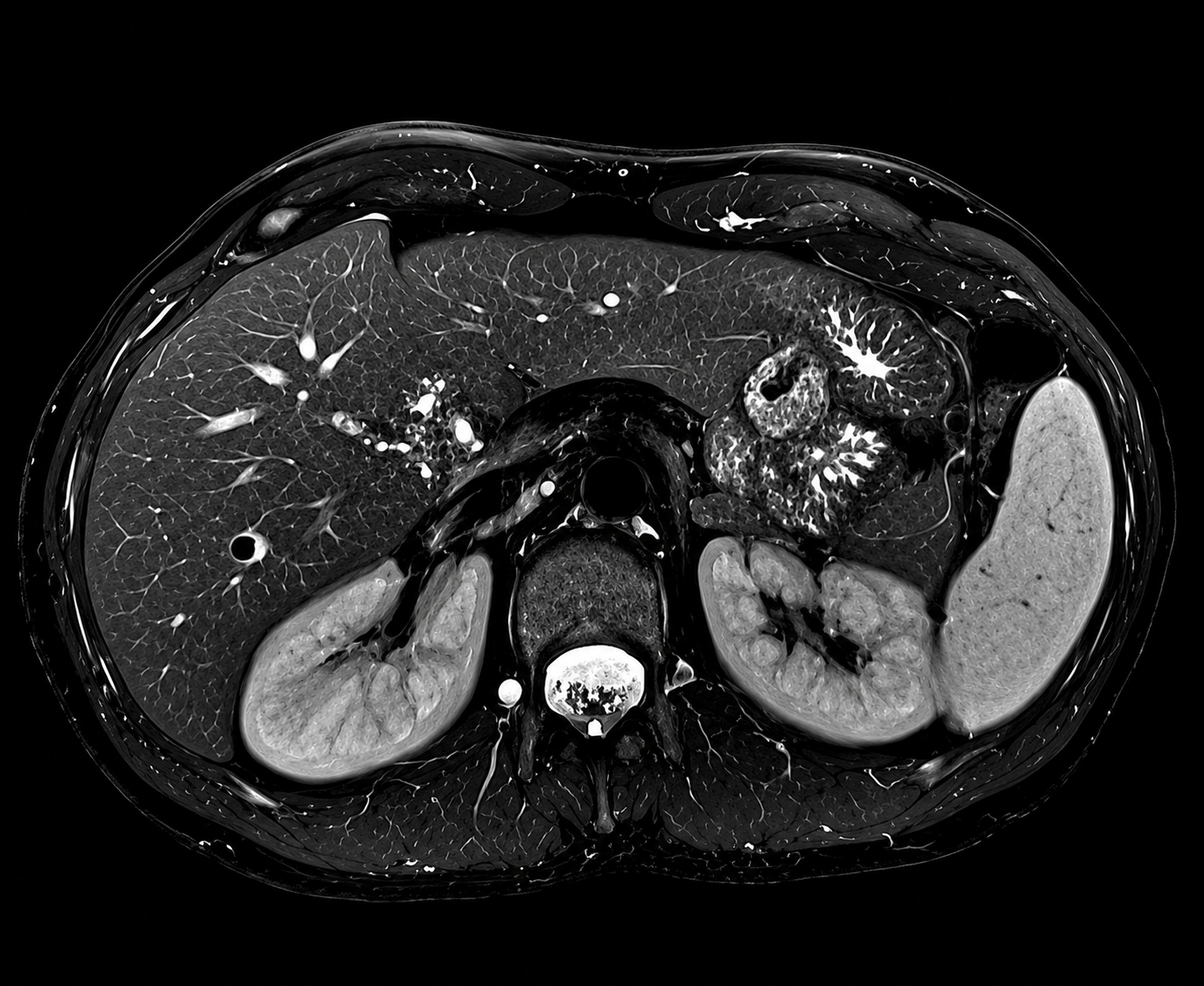
The MRI image above shows a cross-section through the upper abdomen. The liver, pancreas, spleen, kidneys and surrounding tissues are visible, among other things. An MRCP examination uses special MRI sequences to image the bile ducts and the pancreatic duct system in high detail.
When is MRCP recommended?
MRCP is particularly appropriate when problems with the biliary tract or pancreas are suspected, or when previous examinations have not provided sufficient information.
- Unexplained pain in the upper abdomen
- Elevated liver or biliary tract tests (e.g. ALP, GT, bilirubin)
- Suspected gallstones in the bile ducts
- Recurrent pancreatitis (inflammation of the pancreas)
- Jaundice (icterus) without a clear cause
- Abnormal findings on ultrasound or CT
MRCP is often used when suspected of:
- Gallstones in the bile ducts (choledochal calculi).
- Narrowings or blockages in the bile ducts.
- Inflammation of the bile ducts or pancreas (e.g. cholangitis or pancreatitis).
- Cysts or tumor changes in the pancreas.
- Congenital abnormalities of the bile or pancreatic ducts.
- Follow-up after previous illness or intervention in the bile ducts/pancreas.
Which examination is most appropriate always depends on the medical issue. For example, if pancreatic cancer, acute biliary tract disease or other serious conditions are suspected, other imaging diagnostics or hospital examination may need to be prioritized.
How the bile ducts can be seen during MRCP
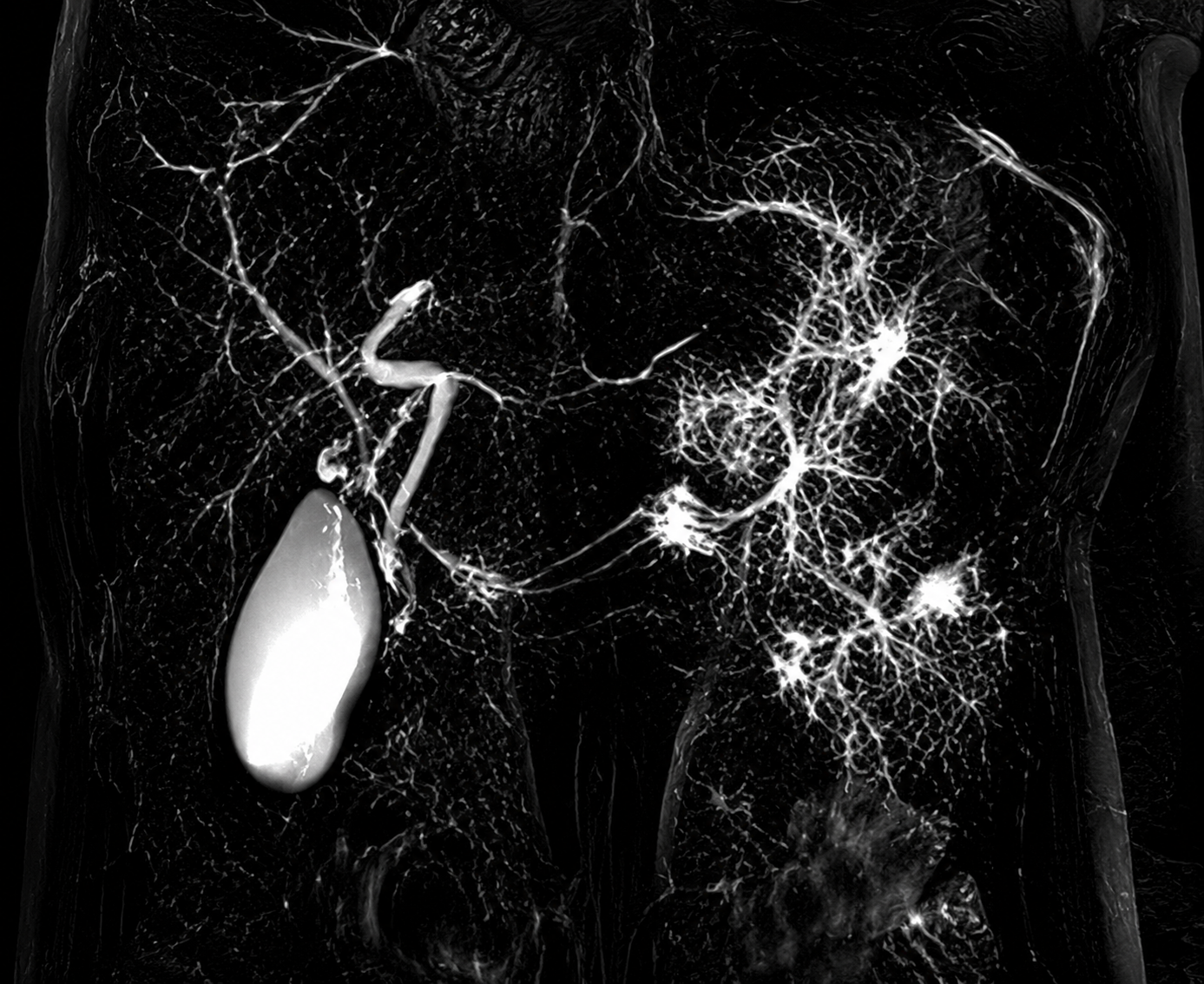
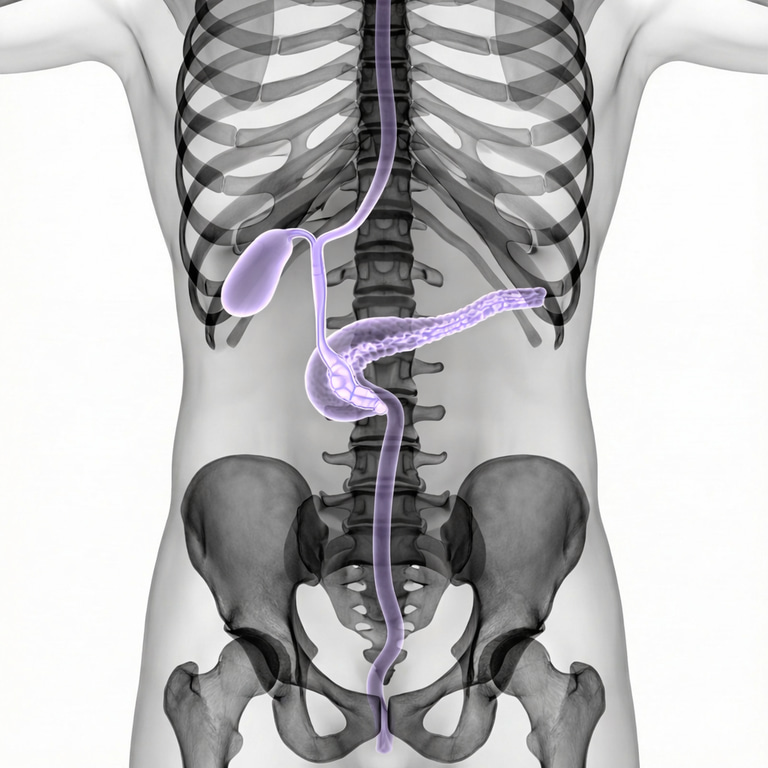
This MRCP image is designed to clearly visualize fluid-filled structures in the biliary system. The gallbladder appears bright together with the branched bile ducts in the liver and the larger bile ducts that carry bile from the liver.
MRCP is a special type of magnetic resonance imaging examination that is used to examine the bile ducts, gallbladder and pancreatic duct system without ionizing radiation. The images can, among other things, help the radiologist assess the shape, course and possible changes of the bile ducts.
The difference between MRCP and abdominal MRI
MRCP and abdominal MRI are both magnetic resonance imaging examinations, but they have different focuses.
MRCP is particularly optimized for visualizing the bile ducts and pancreatic duct. It is therefore very useful when the question concerns, for example, bile duct stones, strictures, outflow obstructions or changes in the duct system.
Abdominal MRI instead provides a broader assessment of several organs and tissues in the abdomen, such as the liver, pancreas, kidneys and other structures.
An MRCP is therefore not a more comprehensive version of abdominal MRI, but a specialized examination with a different diagnostic focus. Depending on the question, MRCP can be combined with other MRI sequences so that both the biliary system and surrounding organs can be assessed.
During the medical assessment prior to the examination, it is decided which MRI protocol best answers the question at hand.
MRCP for suspected gallstones in the bile ducts
MRCP is an important examination for suspected gallstones that have migrated into the common bile duct. Such stones are called choledochal stones and can cause, for example, pain, jaundice, elevated liver values, inflammation of the biliary tract or pancreatitis.
The investigation often begins with a comprehensive medical assessment, blood tests and ultrasound. If there is still a suspicion of bile duct stones without the cause being determined, MRCP or in some cases endoscopic ultrasound (EUS) can be used for further diagnostics.
MRCP and ERCP – what is the difference?
MRCP and ERCP are both used for diseases of the biliary tract, but the examinations have different functions.
MRCP is a diagnostic magnetic resonance imaging examination. It does not require endoscopic instrumentation of the biliary tract and therefore does not involve the procedure-related risks that are present with ERCP.
ERCP (endoscopic retrograde cholangiopancreatography) is an endoscopic procedure that is primarily used when there is also a need for treatment. During an ERCP, the doctor can, for example, remove a bile duct stone, widen a narrowing or place a stent to improve bile flow.
In many situations, MRCP or other non-invasive imaging diagnostics are therefore used to map the bile ducts before a possible treatment procedure is considered.
Is contrast medium needed for MRCP?
The MRCP sequences themselves can visualize the fluid in the bile and pancreatic ducts without intravenous contrast medium. Depending on the question, however, the examination can be supplemented with other MR sequences where contrast medium may be needed.
This is determined based on the medical question and which examination protocol is most appropriate.
Book an MRCP
MRCP provides detailed images of the bile ducts and the pancreatic duct system without using ionizing radiation. The examination is non-invasive and does not require the insertion of instruments into the bile ducts.
MRCP may be a suitable alternative when there is a clear question about the bile ducts or pancreatic duct, but it is important that the right imaging method is chosen based on your symptoms and the medical question.
Medical assessment and dialogue with a doctor are included
When booking an MRCP, a consultation with one of our doctors is always included. We review your symptoms, your medical history, any test results and previous examinations to assess whether MRCP is the right examination for your particular situation.
If another examination is deemed to provide better diagnostic information, we may instead recommend, for example, ultrasound, computed tomography, another type of MRI examination or further investigation within the healthcare system.
The medical assessment is important to ensure that the right examination is carried out from the start and that the result is as relevant as possible to the current question.
When is MRCP not suitable?
MRCP is a targeted examination of primarily the biliary tract and the pancreatic duct system and does not replace a general investigation of all types of abdominal complaints.