
Quick version
What is a herniated disc?
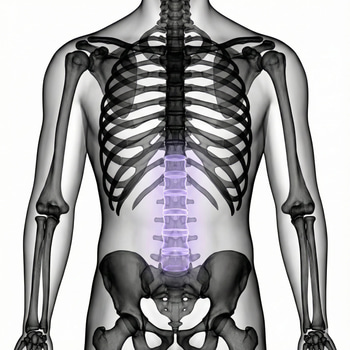
Between the vertebrae of the spine are discs that act as shock absorbers. A disc consists of a core and a stronger outer ring. When the outer ring weakens, the disc may bulge (disc bulging) or rupture completely so that the inner core pushes through, known as a herniated disc (extrusion).
Differences between disc bulging, protrusion, and extrusion
In everyday language, the word herniated disc is sometimes used for all of these conditions. In medical contexts, however, a distinction is made between bulging, protrusion, and extrusion, as they describe different degrees of injury.
- Disc bulging means that the disc bulges evenly without the outer ring breaking. This is therefore not a herniated disc in the strict medical sense.
- Protrusion is when the inner core presses against a weak part of the ring that bulges more locally, but the ring is still intact.
- Extrusion (herniated disc) means that the ring has ruptured and the inner core has pushed through, which can press on nerve roots.
Paramedian herniated disc
A paramedian herniated disc is located slightly backward and to one side of the spine. It is a common condition in the lumbar spine and is positioned so that it can press on a specific nerve root, causing pain and symptoms in one leg.
Symptoms of lumbar herniated disc
When a disc ruptures and presses on a nerve root, it can cause symptoms such as:
- Lower back pain
- Sciatica – radiating pain down the leg
- Reduced sensation, tingling, or numbness
- Muscle weakness in the leg or foot
When should you seek medical care?
Seek emergency care if you have:
- Difficulty controlling urination or bowel movements
- Severe muscle weakness or numbness in both legs
- Numbness in the genital or saddle area (so-called saddle anesthesia)
If you have long-lasting pain in the lower back or leg, reduced sensation, or difficulty bearing weight on the leg, you should contact a healthcare provider for evaluation, but you usually do not need to seek emergency care.
Examinations and diagnosis
The doctor performs a clinical examination of sensation, reflexes, and muscle strength, and then makes an overall assessment based on your medical history and the examination results. Magnetic resonance imaging (MRI) is often used to confirm the herniated disc and to determine its location.
Treatment and prognosis
Most herniated discs heal within a few months. Treatment usually consists of pain relief with medication, physiotherapy and mobility exercises, as well as active self-care with walking and adapted training. In cases of severe nerve involvement or if the pain does not improve with self-care, surgery may be necessary to relieve the pressure on the nerve.
Exercising with a herniated disc
Adapted exercise is recommended in cases of herniated disc as it helps strengthen the surrounding muscles and improve mobility. Commonly recommended forms of training include light walking, mobility exercises for the hips and back, and core-stabilizing training. Note that exercises should always be adapted to your symptoms and carried out in consultation with a physiotherapist.
Can I do anything to prevent a herniated disc?
To reduce the risk of new problems, it can be helpful to maintain an active lifestyle, train core and back muscles regularly, vary working positions, and avoid heavy lifting performed incorrectly.