
Quick version
PI-RADS is a standardized five-point system that grades the likelihood of prostate cancer requiring treatment on MRI, where 1–2 means low risk, 3 is an intermediate level that is difficult to interpret and 4–5 indicates high suspicion. The scale does not establish a diagnosis in itself, but is always weighed together with factors such as PSA value, heredity and, above all, PSA density (PSA in relation to the volume of the prostate). Therefore, two people with the same PI-RADS number can be recommended completely different measures, from active follow-up with blood tests to targeted tissue samples (biopsies).
When the result from a prostate MRI lands in the inbox, many people immediately get stuck on the number: PI-RADS 2, 3 or maybe 4. It may feel like the whole message depends on a single number, but the scale actually says something more specific: how likely it is that the MRI image shows a change that corresponds to clinically significant prostate cancer. It helps the doctor decide whether the next step should be calm follow-up, closer monitoring or tissue sampling.
PI-RADS 1–5: how the result from a prostate MRI can be understood
PI-RADS stands for Prostate Imaging Reporting and Data System. It is an international system for describing findings during magnetic resonance imaging of the prostate in a standardized way. The version used in modern clinics is PI-RADS v2.1, developed to improve how prostate MRI is performed, interpreted and reported.
The scale goes from 1 to 5. The higher the number, the greater the likelihood that the area on the MRI corresponds to clinically significant cancer, i.e. a cancer that may require treatment or close follow-up. PI-RADS is not a diagnosis in itself, however, and the answer must always be weighed together with PSA, PSA density, heredity, prostate size, previous biopsies and medical examination.
What do PI-RADS 1–5 mean in practice?
PI-RADS 1 means that the MRI examination sees a very low probability of clinically significant prostate cancer. PI-RADS 2 means low probability. In both of these situations, there is often no clearly suspicious area on the images, although other follow-up may still be needed depending on the PSA and other risk factors.
PI-RADS 3 is the intermediate category. It is used when the finding is unclear or difficult to interpret. For you as a patient, it usually does not mean that cancer is likely, but neither does it mean that it can be safely ruled out. That is why other factors become extra important, especially PSA density and whether there is prostate cancer in the family.
PI-RADS 4 means a high probability of clinically significant cancer. PI-RADS 5 means a very high probability. In the PI-RADS system, category 5 is used, among other things, when the change has the same type of strong suspicion as category 4 but is also larger, at least 1.5 cm in largest diameter, or shows clear growth outside the prostate.
A simple way to think about it is this:
- PI-RADS 1–2: MRI indicates no significant cancer
- PI-RADS 3: MRI does not provide a certain answer
- PI-RADS 4–5: MRI clearly indicates that further investigation is needed
How is a PI-RADS response to prostate MRI assessed?
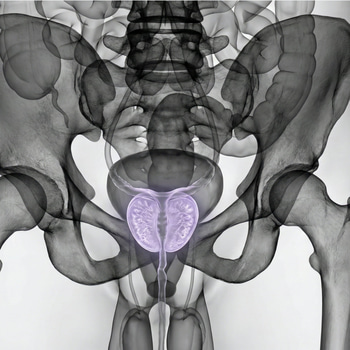
A prostate MRI is usually based on so-called multiparametric MRI, where several image series are combined to assess the tissue. The radiologist looks in particular at how the area looks anatomically, how water molecules move in the tissue and sometimes how contrast is taken up. Different parts of the prostate are weighted differently in the PI-RADS system, because cancer can look different in the peripheral zone and the transition zone.
This means that the number is not set arbitrarily. It is based on fixed rules of interpretation. In the peripheral zone, diffusion sequences are usually most important for the main assessment, while T2-weighted images weigh more heavily in the transition zone. Contrast series can sometimes help to raise a questionable finding, especially from category 3 to 4 in certain situations.
For the patient, this is rarely noticeable in the answer, which often only states a number and where in the prostate the finding is located. But behind the short formulation there is a structured analysis. Therefore, it is also wise to ask the doctor to explain where the change is located, how large it is and whether the radiologist describes the capsule or surrounding tissue as normal.
What happens after PI-RADS 2, 3, 4 or 5?
The next step is not determined by the MRI answer alone. It is recommended to perform MRI before biopsy in cases of suspected localized prostate cancer, and subsequent management is guided by both PI-RADS and clinical risk.
In PI-RADS 1–2, biopsy can sometimes be waived if the clinical suspicion is also low, for example, in the case of low PSA density and lack of heredity. PSA follow-up can be considered instead when MRI is negative and PSA density is below 0.20 ng/mL/cc without a family history. This is important information for many men who worry that a biopsy must always follow an elevated PSA.
In PI-RADS 3, the decision becomes more individual. If the clinical suspicion is very low, for example, PSA density below 0.10 ng/mL/cc and no family history, in some cases it is possible to follow PSA instead of going directly to biopsy. In other cases, targeted biopsy is recommended, often with sampling in and around the suspicious area.
In the case of PI-RADS 4–5, targeted biopsy is more often used. When MRI is positive, especially at PI-RADS 4 or higher, targeted samples should be combined with perilesional sampling, i.e. sampling also in the tissue around the suspicious finding. In many cases, this is also combined with systematic biopsies to reduce the risk of missing significant cancer elsewhere in the prostate.
Common patient questions about PI-RADS answers
A common question is: “Does PI-RADS 4 mean that I have cancer?” The answer is no. PI-RADS indicates the probability on MRI, not a definitive cancer diagnosis. A tissue sample is required to make a diagnosis. At the same time, a PI-RADS 4 or 5 finding is suspicious enough that further investigation is usually justified.
Another question is: “Can you have cancer despite PI-RADS 1 or 2?” Yes, it is possible. MRI is a powerful tool, but it is not perfect. A negative MRI result reduces the likelihood of clinically significant cancer, but does not completely eliminate it. Therefore, PSA, PSA density, heredity and symptoms are still taken into account.
Many also wonder what PI-RADS 3 actually means. Think of it as a borderline case. For example, a man with a slightly elevated PSA, large prostate and low PSA density can often be followed without immediate biopsy, while another man with the same MRI number but a small prostate and high PSA density may need a tissue sample more quickly. The same PI-RADS number can therefore lead to different decisions depending on the context.
Another question concerns symptoms. MRI and PI-RADS are mainly used for cancer investigation, not to explain common urination problems. Frequent urges, weak stream and nighttime urination are more often due to benign prostatic hyperplasia than to prostate cancer. A PI-RADS response must therefore be interpreted separately from symptoms, even though both can be present at the same time.
How PSA and PSA density affect the interpretation of prostate MRI
For many patients, it becomes confusing when PSA is elevated but MRI shows PI-RADS 2, or when PSA is only moderately elevated but MRI shows PI-RADS 4. Here, PSA density becomes a useful concept. It is the PSA value divided by the volume of the prostate, i.e. a way of relating PSA to how large the prostate is. A large, benignly enlarged prostate can give higher PSA without cancer.
That is precisely why PSA density is used in the guidelines when assessing whether biopsy can be postponed at PI-RADS 1–3. A low PSA in a small prostate may be more suspicious than a higher PSA in a very large prostate. For those who read their results at home, this may explain why the doctor sometimes recommends calm follow-up even though the PSA is above the reference range.
If you have received an MRI result, it is wise to ask for three specific things: your PSA value, the volume of the prostate and whether the PSA density has been calculated. This will often make the conversation about the next step much clearer. This is especially true if the result includes PI-RADS 3, where decisions often balance between avoiding unnecessary biopsies and not missing cancer that requires treatment.
A PI-RADS result should therefore not be read as a final answer but as part of a larger puzzle. When MRI findings, blood tests and individual risk factors are put together, the picture becomes much more useful than the number alone. For many, this means that the road ahead will be less dramatic than the number first made it seem.