
Quick version
Neck and shoulder pain can be caused by anything from muscle tension to nerve root impingement and spinal cord compression. MRI is a powerful tool for detecting herniated discs and stenosis, but is mainly used for neurological symptoms, warning signs or failure to improve. Since MRI findings are common even in people without symptoms, the images must always be put in relation to your actual symptoms.
Neck and shoulder pain often comes on insidiously. It can start as stiffness after a day at the computer, a dull ache between the shoulder blades or pain that radiates into the shoulder when you turn your head. For some, the discomfort stops there. For others, numbness, decreased strength or a feeling that the hand does not really obey are added.
From ordinary stiffness to pinched nerves - this is how to understand pain in the cervical spine
Neck and shoulder pain is a broad symptom, not a diagnosis. The pain can come from muscles, joints, discs, nerve roots or from structures in the cervical spine itself. Therefore, the symptom picture becomes important when trying to understand the cause.
Many people describe neck pain that radiates to the shoulder, shoulder blade or upper arm. Pain from the cervical spine can also cause referred pain, which means that the brain interprets the signal as coming from the shoulder even though the cause is in the neck. This is a common explanation when shoulder problems and neck problems overlap.
When a nerve root in the cervical spine becomes irritated or pinched, it is called cervical radiculopathy. In this case, it is common to have pain that radiates from the neck into the shoulder and arm, sometimes accompanied by tingling, numbness or weakness in certain muscles. The symptoms often follow a pattern that corresponds to the affected nerve root.
Some symptoms require a faster assessment. This applies in particular to walking difficulties, clumsiness in the hands, pronounced weakness, balance problems, increased reflexes or effects on the bladder and bowel. These types of findings may indicate effects on the spinal cord, so-called cervical myelopathy, where delayed diagnosis can lead to worse outcomes.
Other warning signs include fever, unexplained weight loss, nighttime pain that does not go away with rest, previous cancer, immunosuppression, recent infection or trauma. Then you need to think more broadly than just normal wear and tear and consider infection, inflammatory disease, fracture or tumor.
Anatomy of the vertebral column – how the cervical spine works
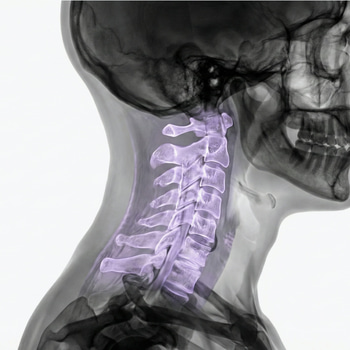
The cervical spine is the uppermost part of the vertebral column and consists of seven cervical vertebrae, C1 to C7. Although there are seven vertebrae, there are eight nerve roots, C1 to C8. The first seven cervical nerve roots leave the spine above each vertebra, while C8 exits between C7 and T1.
Between the vertebrae are discs that act as shock absorbers and help the neck move smoothly. The vertebral column also contains facet joints, ligaments and a more spacious spinal canal system than further down the back, since the spinal cord passes here. It is precisely the combination of mobility and sensitive nerve structures that makes the cervical spine both functional and vulnerable.
The nerve roots from the cervical spine supply sensation and muscle power to the neck, shoulders, arms and hands. A simplified example is that C5 is often associated with the shoulder and upper arm, while C6 and C7 more often cause symptoms further down the arm and hand. Therefore, the doctor often asks exactly where the pain is located, which fingers are numb and whether you lose strength when lifting, gripping or pressing buttons.
This is also why two people with “neck pain” can have completely different conditions. One has muscular pain after static work, the other has a disc that bulges against a nerve root, and a third has congestion in the spinal canal with an impact on the spinal cord. The symptoms therefore guide both the examination and whether an MRI of the cervical spine is justified.
What conditions can cause neck and shoulder pain?
The most common cause is non-specific neck pain, often linked to muscle tension, overload or age-related changes in joints and discs. The pain is then mainly localized in the neck and shoulder area and can be aggravated by static postures, stress or unilateral movements.
A common specific condition is cervical radiculopathy. In this case, a disc or bone spur in a nerve root exit, so-called foraminal stenos, presses against the nerve. This can cause sharp or burning pain that radiates into the shoulder and arm, sometimes with reduced sensation, weakness or altered reflexes. MRI is the best method here to assess soft tissues, discs and nerve damage.
A more serious condition is degenerative cervical myelopathy. In this case, narrowing in the cervical spine has begun to affect the spinal cord, not just an individual nerve root. The patient may seek treatment for neck pain and shoulder pain, but what often raises suspicion is poorer fine motor skills, a wide gait, balance problems or numbness in both hands and legs. MRI is the first-line method for confirming compression of the spinal cord.
Sometimes the underlying problem is not in the cervical spine at all. Pain in the shoulder region can be due to rotator cuff problems, impingement, frozen shoulder or local osteoarthritis in the shoulder joint. Conversely, a patient with a “shoulder problem” may actually have nerve root irritation from the neck. This is precisely why both a neurological examination and assessment of the shoulder itself are often included before deciding which imaging diagnosis is reasonable.
When can an MRI of the cervical spine be relevant?
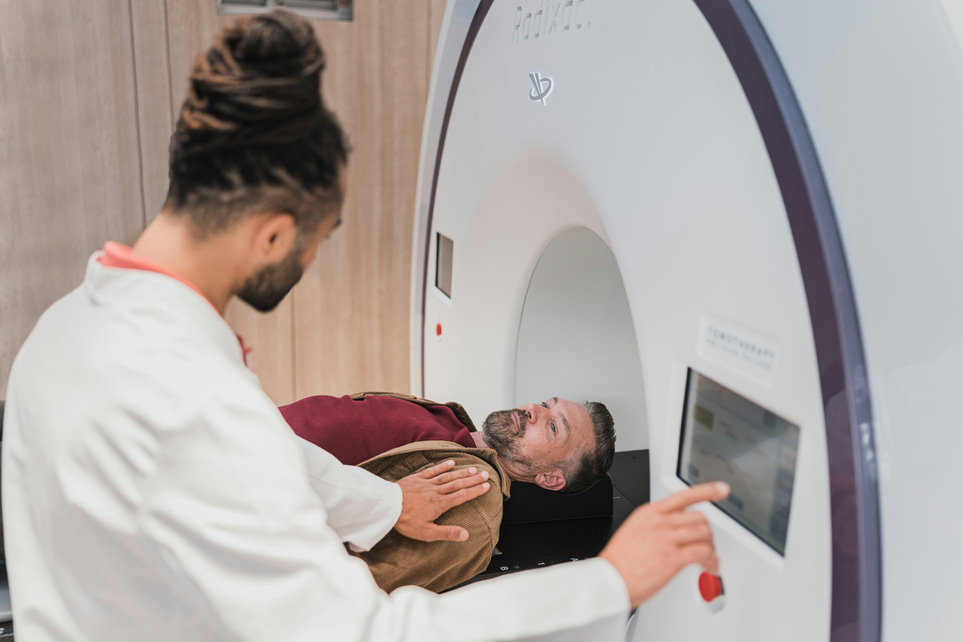
MRI cervical spine is not the first measure for all neck pain. In the case of new neck pain without trauma and without warning signs, clinical assessment and initial conservative treatment are often recommended, since many people get better with time, adapted activity and symptom relief. Furthermore, imaging findings and symptoms do not always match; Many adults have age-related changes on MRI without any problems.
MRI becomes more relevant when symptoms indicate nerve damage or when the course does not follow the expected pattern. This applies, for example, to persistent radiation in the arm, progressive weakness, loss of sensation, suspected myelopathy or lack of improvement after several weeks of treatment. MRI without contrast is not normally the first choice for non-specific neck pain without red flags, but becomes relevant for neurological issues and more complex clinical conditions.
A practical example is the person who has had neck and shoulder pain for two months and now gets numbness in the thumb and index finger when the head is bent backwards. Another is if you first tested for a stiff neck but then start to lose grip strength and fumble with a keyboard or tools. In such cases, MRI often provides more valuable information than plain X-ray, since the examination shows the discs, nerve roots, spinal canal and spinal cord.
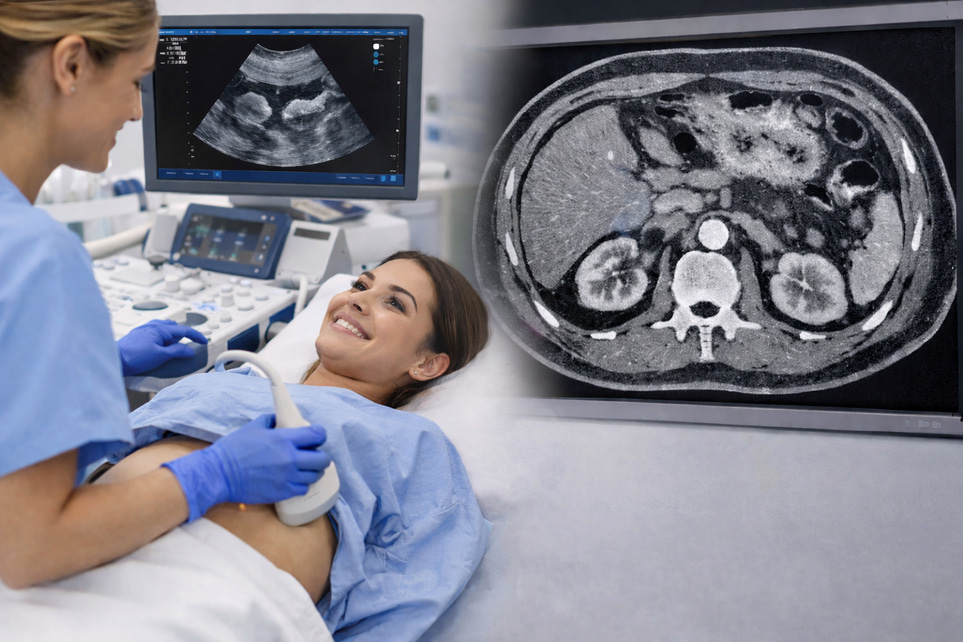
In the event of trauma, suspected fracture or clear skeletal involvement, CT may be more important in the acute stage. If the question concerns infection, tumor or previous surgery, MRI can sometimes be done with contrast depending on the clinical situation. The choice of examination is therefore guided by what you are looking for, not just by where it hurts.
What examinations and questions are relevant before an MRI of the cervical spine?
A MRI of the cervical spine is best when the referral contains a clear clinical question. The radiologist needs to know whether a herniated disc, nerve root compression, spinal stenosis, myelopathy, inflammation, tumor or post-traumatic changes are suspected. “Neck pain” as a single question is less accurate than a referral that describes the pattern of symptoms and findings during examination.
The clinical assessment usually includes:
- the location, duration and radiation of the pain
- numbness, tingling, weakness and fine motor skills
- walking ability, balance and possible bladder symptoms
- trauma, fever, weight loss, previous cancer and signs of infection
- whether the symptoms are provoked by neck movements or relieved in certain positions
The status often includes range of motion in the neck, palpation, neurological examination of the arms and sometimes legs, as well as tests that can support suspicion of radiculopathy. For example, Spurling's test can elicit radiating arm pain in the event of nerve root irritation, while findings such as hyperreflexia, Babinski, clonus or gait impairment are more suggestive of myelopathy.
Common questions on an MRI referral may be:
- Is there a herniated disc or disc bulge that explains the radiating pain to the shoulder or arm?
- Is there foraminal stenosis with compression of the C5, C6, C7 or C8 root?
- Is there central spinal stenosis or signs of spinal cord compression?
- Are there signal changes in the spinal cord that may indicate myelopathic changes?
- Is there another explanation, such as a tumor, infection or inflammatory process?
In some cases, other examinations are supplemented. Neurophysiology, such as EMG, can be helpful if you need to distinguish between radiculopathy and peripheral nerve involvement, such as carpal tunnel syndrome or ulnar nerve involvement. If shoulder disease is clearly suspected, ultrasound or MRI of the shoulder joint may be more relevant than MRI of the cervical spine.
An important detail is that the MRI response must always be interpreted together with the patient's symptoms and status. Degenerative changes, disc bulges and narrow foramina can also be seen in people without symptoms. A good assessment is therefore not only about finding abnormalities, but also about determining which of them actually explain the patient's problem.