Quick version
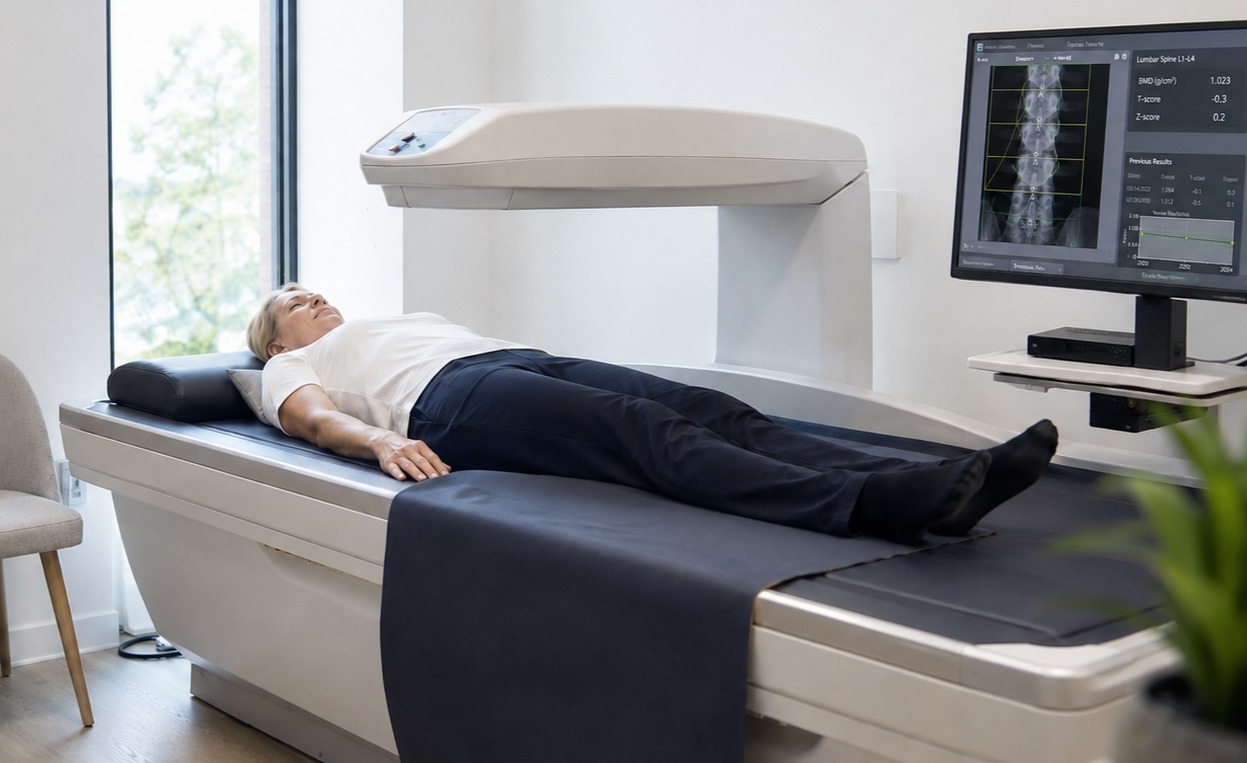
For many, a DEXA, or bone densitometry, feels like a test you do once and then don't need to do it again. In reality, the question is more practical than that: how often should you do a DEXA if you want to catch ongoing bone loss, monitor the effect of treatment or assess the risk of future fractures? The answer depends on what the examination will lead to in healthcare.
How often should you do a DEXA if you are healthy and not being treated?
There is no single standard interval that fits everyone. Current guidelines emphasize that follow-up bone density measurements should be done when the result can actually affect the treatment, not as a routine without a clear purpose.
For a person without a known osteoporosis, without a previous fragility fracture and without medications or diseases that accelerate bone loss, frequent checks are therefore often not needed. If the first DEXA measurement is normal or only shows slightly reduced bone density, and the risk profile is otherwise low, the interval can be long. This is also the reason why screening recommendations focus primarily on who should be screened, rather than specifying a fixed schedule for repeated measurements.
In practice, two people of the same age may receive different advice. A 67-year-old woman with normal bone density, good physical activity and no risk factors can often wait significantly longer than a person of the same age with low body weight, smoking or early menopause.
When does DEXA need to be repeated more often?
Shorter intervals become relevant when bone mass can change more quickly than normal. This applies, for example, to:
- treatment with glucocorticoids such as prednisolone
- aromatase inhibitors for breast cancer
- hormonal treatment for prostate cancer
- malabsorption, for example after certain intestinal diseases
- bariatric surgery, for example gastric bypass surgery
- prolonged immobilization
- surgical menopause (removed ovaries)
- severe inflammatory systemic diseases
In such situations, a new DEXA may be needed after 1–2 years, sometimes even more guided by the clinical image.
A common patient question is: “I had almost normal bone density two years ago, do I need to measure it again now?” If you have since had a spinal compression, started taking cortisone or experienced rapid weight loss, the answer is often yes. A new clinical risk factor sometimes weighs more heavily than the length of time that has passed.
How often should you do a DEXA during treatment for osteoporosis?
When osteoporosis is treated, DEXA is used not only for diagnosis, but also to monitor whether the treatment seems to be having the intended effect. Bone density measurement is often repeated after 1–2 years of starting or changing osteoporosis medication to assess the treatment response.
This does not mean that everyone needs annual checks for the rest of their lives. When bone density is stable and the treatment is working, the intervals can often be reduced. For those treated with bisphosphonates, follow-up DEXA can also be used before a planned treatment break.
When should you react immediately instead of waiting for the next DEXA?
A new fragility fracture is such a situation. If someone has a hip, wrist or other low-energy fracture, this should lead to a new risk assessment. The same applies if you suddenly become much shorter, have new back pain without a clear explanation or if an X-ray for another reason shows vertebral compressions. In this case, it is not primarily the time since the last DEXA that is decisive, but the new clinical information.
A DEXA is therefore not a test that should be booked "as often as possible", but when the result can change the next step. The truly valuable question is therefore not only when you last measured, but whether your risk profile has changed since then.
Do you want to know what your bone density looks like? Order a Bone density measurement from us at Testmottagningen.se and receive a medical report that can be used as a basis for continued assessment and possible preventive measures or treatment.