
Quick version
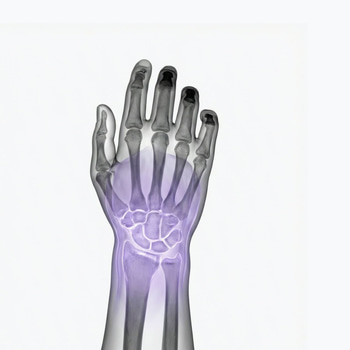
Pain and clicking on the little finger side of the wrist is often due to an injury to the TFCC – the wrist’s shock absorber and stabilizer. The injury can occur acutely through a fall or gradually through long-term wear and tear from work or sports. Since the TFCC consists of cartilage and ligaments, it is not visible on a regular X-ray, but often requires a clinical examination or MRI.
Most people get better with rest, wrist support and targeted hand therapy. During healing, you should pause heavy twisting and pressing exercises such as push-ups. If the discomfort does not subside or if the wrist is unstable, keyhole surgery may be considered. Seek medical attention if the pain persists for more than a few weeks or has occurred after a fall.
Do you have pain on the little finger side of your wrist when you turn a doorknob, lift a frying pan or do push-ups? Then it is not uncommon for the problem to be in the TFCC – the triangular fibrocartilage complex. Injuries to this area are a common cause of wrist pain, especially after falls on an outstretched hand, during repeated twisting movements or in people who put a lot of strain on the wrist in work or sports. The TFCC functions as a combination of shock absorber and stabilizer on the ulnar side of the wrist, i.e. the side where the little finger is located. When the structure is damaged, both pain, clicking and a feeling of instability can occur.
What does damage to the triangular fibrocartilage complex mean?
TFCC stands for triangular fibrocartilage complex, in Swedish triangular fibrocartilage complex. It is not a single tendon or piece of cartilage, but a whole small support system in the wrist. It consists of fibrous cartilage, ligaments and supporting tissue that help to:
stabilize the joint between the radius and ulna at the far end of the wrist
absorb stress on the little finger side of the wrist
provide support when twisting the forearm, for example when you are screwing, opening cans or using tools
A TFCC injury can be traumatic or degenerative. A traumatic injury often occurs suddenly, for example after a fall or a severe twisting force. A degenerative injury develops more gradually through wear and tear, often in middle-aged or elderly people or in those who have long-term unilaterally loaded the wrist. Both types can cause similar symptoms, but the cause and treatment may differ.
It is also important to understand that ulnar-sided wrist pain – i.e. pain on the little finger side – can have several causes. TFCC injuries are common, but the pain can also be due to, for example, tendon sheath problems, osteoarthritis, joint instability or the impact of a previous fracture. Therefore, a careful assessment is often required to make the correct diagnosis.
What symptoms does a TFCC injury cause?
Many patients describe the symptoms quite typically: “It hits the outside of the wrist when I rotate my forearm” or “it clicks when I put weight on my hand”. Common symptoms of injuries to the triangular fibrocartilaginous complex are:
pain on the little finger side of the wrist
pain when turning the forearm, for example when turning a key or opening a lid
pain when straining, especially when supporting yourself on your hand
clicking or snapping sensation in the wrist
reduced strength in the hand
sometimes swelling or tenderness over the area
feeling that the wrist is weak or unstable
With a more pronounced injury, you may also have problems with range of motion and grip strength. Some people notice the discomfort most during exercise or work, while others feel pain during everyday activities such as carrying grocery bags or lifting a child. There are also people who have a minor injury on MRI without particularly clear symptoms, which shows that examination findings must always be interpreted together with the patient's symptoms.
A common question is: Can a TFCC injury heal on its own? The answer is that some injuries improve with offloading, orthosis and rehabilitation, especially if the joint is stable. Other, especially more peripheral injuries with instability, may require surgical evaluation.
Why do injuries occur in the triangular fibrocartilaginous complex (TFCC)?
There are two main groups of causes, both acute injury and wear and tear.
Acute traumatic TFCC injury can occur with:
fall on an outstretched hand
forceful twisting of the wrist
sports with rapid rotation and loading, such as racket sports, gymnastics or contact sports
accidents at work where the wrist is suddenly twisted or loaded
Degenerative TFCC injury is more often seen with:
repeated torques over time
heavy manual work
increasing age
anatomical conditions where the ulna puts more strain on the area than normal, so-called positive ulnar variance.
The latter simply means that the ulna is relatively longer in relation to the radius at the far end of the wrist. This can put more pressure on the TFCC, which in the long run increases the risk of wear and tear and pain.
How is the diagnosis made and what tests are needed?
The diagnosis begins with a medical history and clinical examination. The doctor often asks:
Where exactly is the pain located?
Did it come after a fall or did it creep up on you?
Does it hurt when twisting, lifting or putting weight on it?
Does the wrist feel unstable or does it click?
The examination looks for tenderness on the little finger side, pain when rotating and special clinical tests that provoke the area. It is also assessed whether there are signs of instability in the distal radioulnar joint, i.e. the joint between the forearm bones near the wrist.
The assessment is often supplemented with imaging diagnostics:
A regular X-ray is used to rule out fracture, misalignment and to assess the load conditions of the skeleton.
MRI can show damage to the TFCC and other soft tissues.
Arthroscopy involves looking into the wrist with a camera. It is still described as the most accurate method for confirming certain TFCC injuries, while treatment can sometimes be done immediately.
However, it is important to know that MRI is not perfect. An MRI image must always be weighed against symptoms and clinical findings. A change in the image does not automatically mean that it explains the pain, especially not in the case of age-related wear and tear.
When should you seek care? Seek evaluation if you have:
persistent wrist pain for more than a few weeks
pain after a fall or trauma
obvious weakness, instability, or clicking
difficulty working, exercising, or performing everyday tasks
simultaneous numbness, severe swelling, or malposition, which may indicate a different or more acute injury
How are TFCC injuries treated?
Treatment depends on which part of the TFCC is injured, whether the symptoms are acute or long-term, and whether the wrist is stable.
Non-surgical treatment
Many patients start with conservative treatment, especially if the injury is considered stable. This may include:
relief from provocative activity
orthosis or wrist support for a period
anti-inflammatory or pain-relieving treatment as needed
physiotherapy or hand therapy
gradual return to weight-bearing
The goal is to reduce pain, regain strength and improve stability and function. A systematic review from 2024 shows that non-operative treatment can give good results for selected traumatic TFCC injuries, especially when the joint is stable and the right patients are selected.
Surgical treatment
Operation may be considered if:
the symptoms do not improve despite months of conservative treatment
there is clear instability
the injury is in a part of the TFCC that has better healing conditions and is therefore suitable for repair
other mechanical problems need to be addressed at the same time
Surgery is often performed arthroscopically, i.e. via small instruments and a camera in the wrist. Depending on the type of injury, it can either clean up damaged tissue or repair parts close to the ligaments. More complex cases may require other surgery, for example if the anatomy of the skeleton creates prolonged pressure on the area.
After surgery, immobilization often follows for a period and then structured rehabilitation. How quickly you return to work and sports varies greatly. Office work can sometimes be resumed relatively early, while heavy manual work, racket sports or gymnastics may require significantly longer rehabilitation.
From pain to proper rehab and overall health
Suffering from a TFCC injury often raises many questions, especially since the wrist is so central to our everyday lives. One of the most common concerns is whether it is possible to continue training. The answer largely depends on your symptoms; lighter activities that do not provoke the wrist can work perfectly, while heavy loads such as bench presses, push-ups and rapid twisting movements usually need to be paused completely for a period of time to give the ligaments a chance to heal.
Although a TFCC injury is not dangerous in a medical sense, it should be taken seriously. Without proper management, there is a risk of long-term pain and impaired function, which can quickly affect work ability – especially for those who have a physical profession where the hands are the main tool.