
Quick version
A dementia assessment is performed to determine whether memory problems are caused by dementia or by another treatable condition, such as stress, depression, or vitamin deficiency. The assessment usually consists of conversations, memory tests, blood tests, and brain imaging using both CT and MRI. Relatives are often involved to provide a clearer picture of changes in daily life. In some cases, additional examinations may be needed, such as a spinal fluid test. After the assessment, the patient is informed about the cause of the symptoms and what treatment or support may be needed.
Dementia Assessment – What Does It Involve?
Having to consider whether forgetfulness, word-finding difficulties, or changes in behavior may be caused by dementia often creates concern for both the affected individual and their relatives. Common searches may include “dementia assessment,” “memory assessment,” or “how is a dementia assessment performed” in an attempt to understand what to expect and whether help is available.
However, an assessment is not only about “looking for dementia” – it also aims to identify other, sometimes treatable, causes of memory problems. The Swedish National Board of Health and Welfare recommends that individuals with suspected dementia should be offered a basic dementia assessment, often through primary healthcare, and when necessary a more extensive evaluation at a specialist clinic.
For many people affected by dementia, everything begins with a feeling that something is not right. It may involve losing track during conversations, forgetting appointments more often than before, or noticing that a relative is having increasing difficulty managing finances, medications, or daily routines. Such symptoms may be caused by dementia, but it is important to remember that they can also result from other factors such as depression, stress, sleep deprivation, vitamin deficiencies, thyroid disease, or other physical illnesses. That is why seeking medical care early is advisable.
Dementia Assessment Step by Step – Why Is It Performed?
A dementia assessment is carried out in several stages in order to answer a number of important questions:
Is there actually a cognitive impairment – that is, a decline in memory or other brain functions?
Do the symptoms affect the person’s daily life to such an extent that it may indicate dementia?
Can the symptoms be explained by another treatable condition?
If it is dementia – what type of dementia is it?
What support, treatment, and follow-up are needed?
Answering these questions is essential because “dementia” is not a single disease, but rather a collective term for several conditions that affect the brain. Examples include Alzheimer’s disease, vascular dementia, Lewy body dementia, and frontotemporal dementia. Different diagnoses may result in different symptom patterns, prognoses, and treatments.
According to the Swedish National Board of Health and Welfare guidelines, a basic dementia assessment typically includes cognitive testing, blood tests, and brain imaging with CT or MRI, where the clock drawing test is used as a complement to the MMSE test. These tests and examinations are carried out together with a physician’s evaluation, discussions with the patient, and often also with a close relative.
Interview, Family Input, and Dementia Testing – How the First Part of a Memory Assessment Is Conducted
When performing a memory assessment, the process almost always begins with a thorough conversation. The doctor asks when the symptoms started, how they have developed, and which situations have become more difficult. This may include:
memory for appointments, names, or recently occurring events
orientation in time and place
language and word retrieval
concentration and planning ability
mood, anxiety, or low mood
walking ability, balance, or neurological symptoms
medications, alcohol consumption, and previous illnesses
During this visit, a close relative is often present. This is not to “speak over the patient’s head,” but rather to provide a more complete picture. Individuals with cognitive difficulties may not always notice all the changes themselves, while a partner, adult child, or close friend may be able to describe how everyday life is actually functioning. This is an important part of the evaluation during a dementia assessment.
After this, one or more cognitive tests are performed. Common examples include MMSE/MMSE-SR and MoCA, which assess memory, orientation, language, attention, and executive functioning. The clock drawing test is often included as part of these tests and is used to evaluate visuospatial ability and planning skills.
.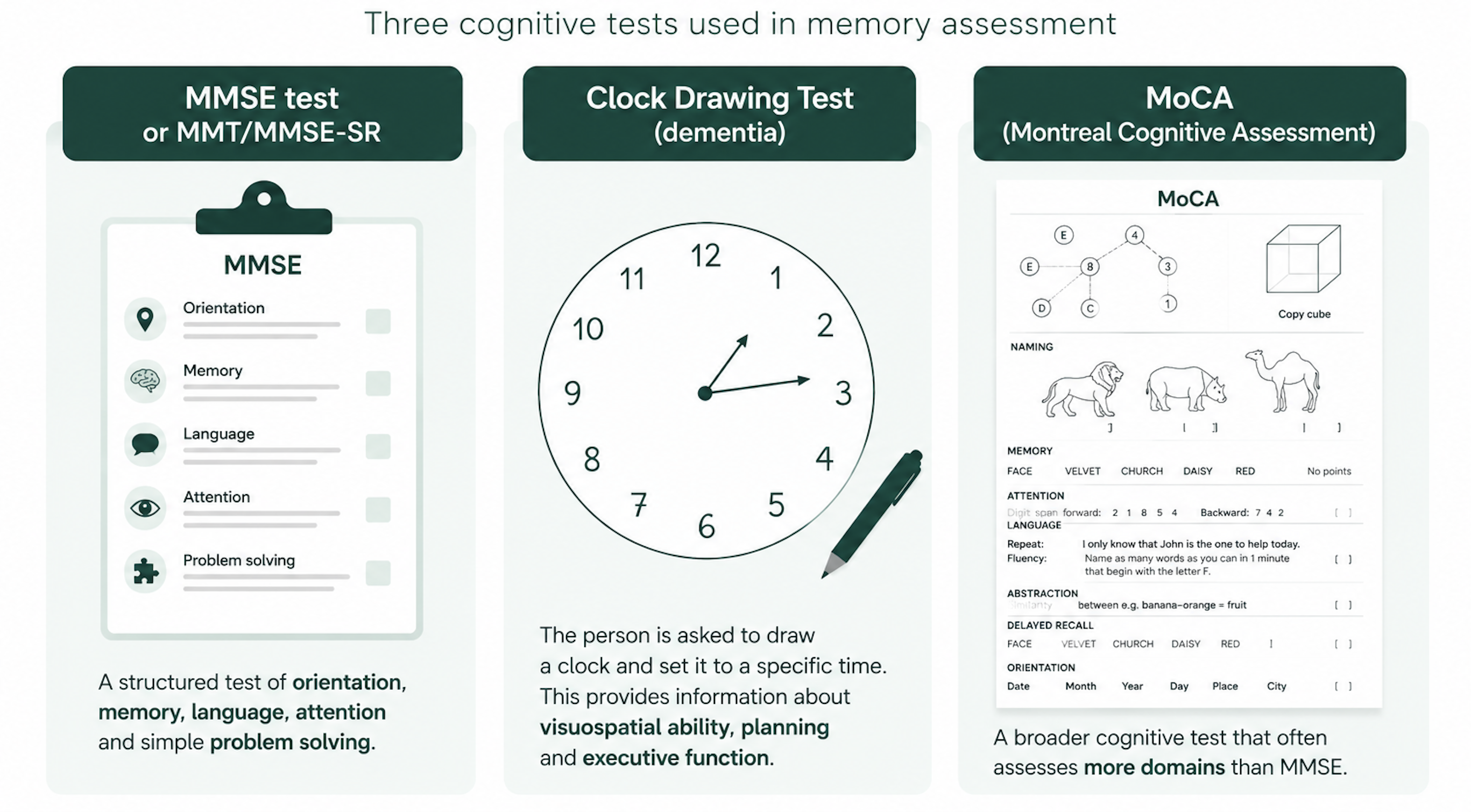
Examples of tests performed during a dementia assessment.
It is important to understand that no single test alone establishes the diagnosis. A low result does not automatically mean dementia, and a normal result does not exclude early disease. The tests must always be interpreted together with medical history, educational background, language, mental well-being, and other examination findings that emerge during the assessment.
Can You Perform a Dementia Test at Home?
There are simple questionnaires and digital tests available online, but these cannot replace a medical evaluation. Home tests may possibly raise suspicion, but they should not be used to self-diagnose dementia. If concerns persist, medical care is necessary. This is also why healthcare providers use standardized tests in the proper clinical context.
Dementia Blood Tests – What Are They Looking For?
Blood tests are an important part of a dementia assessment, but not because a standard blood test alone can “show dementia.” The primary purpose of blood testing is to identify other explanations that may cause memory problems or conditions that may worsen cognitive function. According to 1177, testing commonly includes blood count, blood sugar, calcium, thyroid function, and vitamin B12. In clinical practice, additional tests are often evaluated depending on symptoms and risk factors.
Blood tests may, for example, help detect:
disturbances in the thyroid gland
imbalances in electrolyte or calcium balance
diabetes or poor blood sugar control
This is important because certain conditions can produce symptoms similar to dementia or worsen an already vulnerable brain function. In some cases, treatment can lead to significant improvement.
At the same time, new blood-based biomarkers for Alzheimer’s disease are being developed, such as plasma p-tau and amyloid-related analyses. In recent years, these have become increasingly important in research and certain specialist care settings, but they are not yet included as standard in all basic Swedish dementia assessments. Internationally, rapid developments are ongoing, and the Alzheimer’s Association has both updated diagnostic criteria and published guidelines for the use of blood-based biomarkers in specialist care.
MRI, CT, and Lumbar Puncture – When Are Additional Examinations Needed?
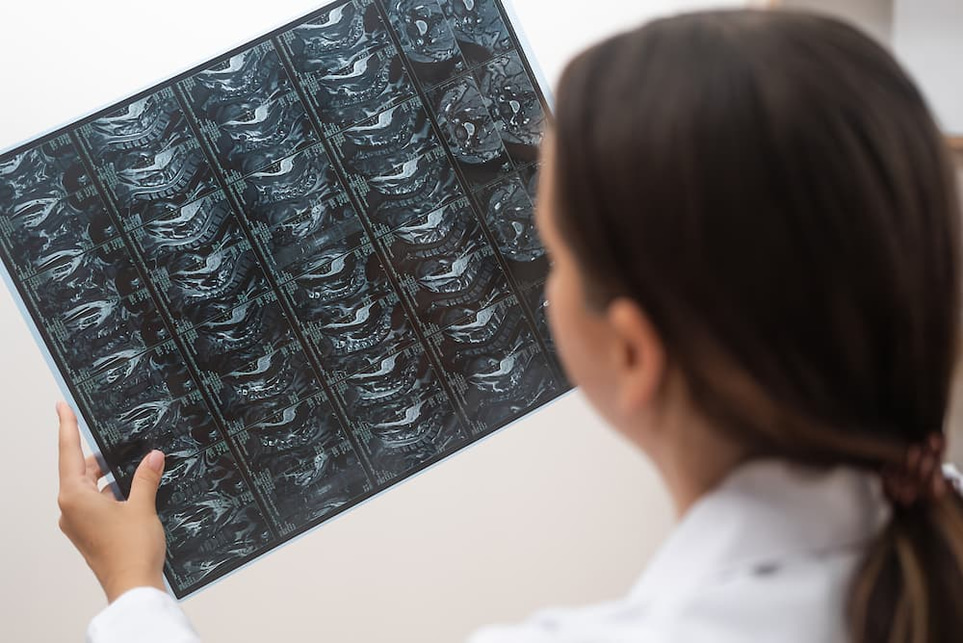
Once the initial assessment has been completed, brain imaging is often the next step. CT is the most common method, but sometimes brain MRI is performed instead. The purpose is not to “see dementia” directly, but rather to identify patterns that support a specific diagnosis while also ruling out other conditions, such as tumors, normal pressure hydrocephalus, previous strokes, or other structural changes. The Swedish National Board of Health and Welfare considers CT or MRI to be part of a complete basic dementia assessment.
The practical difference between a CT scan and an MRI of the brain is often the following:
Brain CT is fast, widely available, and commonly used in basic assessments.
Brain MRI provides more detailed images and can be particularly valuable when the diagnosis is unclear or when vascular changes are suspected.
In some cases, a lumbar puncture is also needed, which involves collecting cerebrospinal fluid. Biomarkers reflecting changes typical of Alzheimer’s disease, such as amyloid and tau proteins, are then analyzed.
Many people wonder whether a lumbar puncture is dangerous. For most individuals, it is considered a safe routine procedure. However, commonly reported side effects include temporary headache or soreness at the puncture site. Serious complications are uncommon. The examination is only performed when the expected benefit is considered clear.
If necessary, specialist care may also include additional examinations such as neuropsychological testing, EEG, or functional brain imaging, including isotope scans or PET scans in selected cases.
What Happens After a Dementia Assessment?
When all parts of the assessment are completed, the patient will usually have a follow-up visit where the doctor reviews the results. At this stage, three questions are addressed: what does the assessment show, what does it mean in everyday life, and what are the next steps? In cases where the cause cannot be determined with certainty right away, a new evaluation may be needed after some time.
If the assessment suggests dementia disease, the next steps may include:
diagnosis and information about the disease
medication treatment when appropriate
follow-up in primary care or specialist care
support for relatives
assistive devices, occupational therapy assessment, and municipal support services
If the assessment instead reveals other causes, the focus may shift toward treating those conditions. As mentioned above, this may involve anything from depression and medication side effects to nutritional deficiencies, vascular risk factors, or other physical illnesses. This is precisely why it is so important for anyone with suspected dementia or memory problems to seek medical care early.
If you or a loved one recognize yourselves in the description above, it is wise to contact your primary healthcare center for an evaluation. And if you would also like to gain a better overview of health markers that may affect the brain, blood vessels, and general well-being, a health check can be a reassuring first step.