
Quick version
Ankylosing spondylitis (Bechterew's disease) is a chronic inflammatory joint disease that primarily affects the spine and pelvic joints. Typical symptoms include long-term back pain, morning stiffness, and pain that is relieved by movement but worsened by rest. Early diagnosis using symptoms, blood tests, and imaging is important in order to initiate treatment that reduces inflammation, preserves mobility, and improves quality of life.
Do you recognize that your back feels stiff in the morning, that it takes time for your body to “get going” and that the pain paradoxically gets better when you move? Then it is easy to think that it is about poor posture, stress or a sedentary job. But sometimes long-term back pain can be due to an inflammatory joint disease. Ankylosing spondylitis, also known as Bechterew's disease, is a form of axial spondyloarthritis that primarily attacks the joints in the pelvis and spine. The disease cannot be completely cured, but with the right diagnosis, treatment and follow-up, many people can live an active and functional life.
What does ankylosing spondylitis mean?
Ankylosing spondylitis is a chronic inflammatory rheumatic disease. The inflammation is often located in the sacroiliac joints, which are the joints between the sacrum and the pelvis. It can also affect the joints of the spine and the ligament attachments where tendons and ligaments attach to the skeleton. Over time, the inflammation can lead to structural changes and increased stiffness. In more severe cases, parts of the spine can become less mobile as new bone formation occurs.
The term axial spondyloarthritis is used today as an umbrella name. Ankylosing spondylitis is the form where changes are visible on a regular X-ray. There is also a related form, non-radiographic axial spondyloarthritis, where symptoms and inflammation are present but where classic X-ray changes are not yet visible. MRI can then sometimes show early signs of inflammation.
The disease usually debuts before the age of 45 and usually develops gradually. Because the symptoms can easily be mistaken for ordinary low back pain, it often takes several years before the correct diagnosis is made.
Common symptoms of ankylosing spondylitis
The most typical is inflammatory back pain. This is different from mechanical back pain, which is often made worse by strain and better by rest. In ankylosing spondylitis, the pattern is often the opposite.
Common symptoms are:
pain deep in the lower back or buttocks
morning stiffness that lasts for a long time
improvement when moving
worse symptoms from rest or sitting still
nighttime pain, especially during the second half of the night
fatigue and malaise
pain in the hips, chest, heels or other tendon attachments
In some people, other parts of the body are also affected. This may include:
eye inflammation (uveitis) with red, painful and light-sensitive eyes
psoriasis
inflammatory bowel disease, such as Crohn's disease or ulcerative colitis
It is important to be aware of these connections, as they can provide clues to the diagnosis and influence the choice of treatment.
Long-term back pain in younger adults that has lasted more than three months, wakes the person at night and is relieved by movement or exercise are typical signs of inflammatory back disease. This symptom pattern should therefore raise suspicion of the diagnosis.
Why does one get Bechterew's disease?
The exact cause is not entirely certain, but both heredity and immunological factors play a role. The gene variant HLA-B27 is strongly linked to the disease, but the connection is not absolute. Many people who carry HLA-B27 never get sick, and some who have ankylosing spondylitis lack the gene variant. Therefore, a blood test can provide information, but it is not enough alone to make or rule out the diagnosis.
It is believed that the immune system of susceptible people reacts in a way that drives long-term inflammation in the joints and tendon attachments. Why this starts in a particular individual is still not fully understood. Environmental factors also seem to play a role.
Many wonder if ankylosing spondylitis is hereditary. The answer is that heredity increases the risk, but this does not mean that the disease is automatically inherited. If you have close relatives with axial spondyloarthritis, psoriasis, uveitis or inflammatory bowel disease, it may be especially important to take long-term symptoms seriously.
How is the diagnosis made and which tests may be relevant?
The diagnosis is based on a combination of medical history, clinical examination, blood tests and diagnostic imaging. The doctor assesses, among other things, how the pain behaves over time, whether the mobility of the back is impaired, whether the chest moves normally and whether there are signs of inflammation in other joints or tendon attachments.
Common parts of the investigation are:
blood tests for CRP and sometimes SR which can show signs of inflammation
tests for HLA-B27
x-rays of the pelvic joints and sometimes the spine
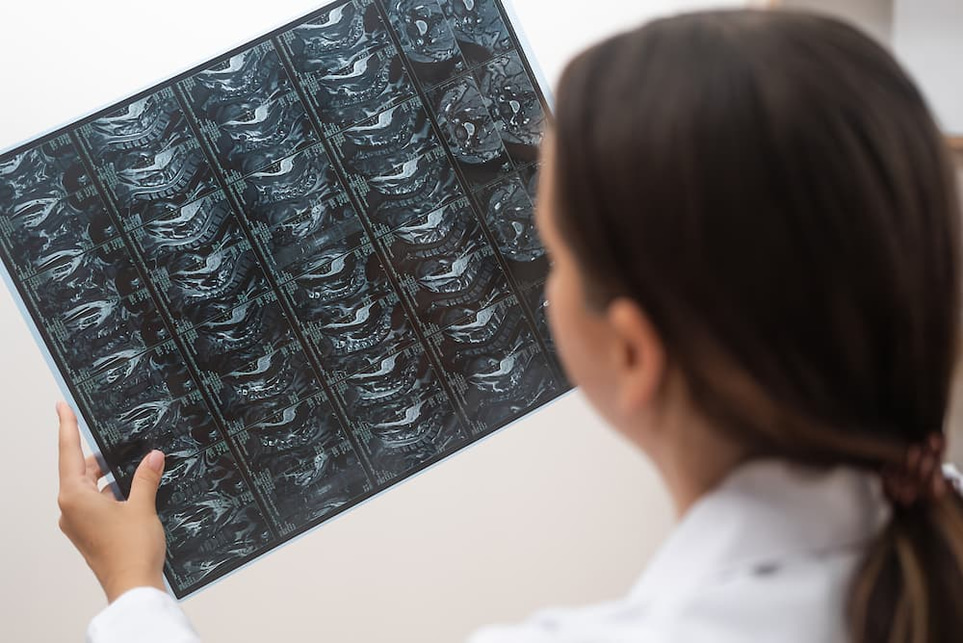
MRI if the x-ray does not show clear changes but the suspicion is still high
It is important to know that blood tests can be normal despite active disease. A normal CRP does not rule out ankylosing spondylitis. Similarly, HLA-B27 is not a “yes or no test”, but a piece of the puzzle in the whole.
Normal blood tests do not rule out axial spondyloarthritis. Inflammatory markers such as CRP and SR can be normal despite active disease, which means that the diagnosis is largely based on the overall clinical picture and correct imaging diagnostics. According to quality recommendations, people with suspected axial spondyloarthritis and a normal plain radiograph should be further investigated with magnetic resonance imaging (MRI) according to an inflammation-focused protocol.
Treatment of ankylosing spondylitis
The treatment aims to:
reduce pain and stiffness
reduce inflammation
preserve mobility, posture and function
prevent or slow down permanent damage
The basis of treatment is often a combination of exercise, physiotherapy and medication. Structured physical activity is central and is widely recommended, as regular movement helps maintain mobility, muscle strength and posture. People with axial spondyloarthritis should also receive support from a physiotherapist regarding exercises that are adapted to the disease.
Drug treatment often begins with NSAIDs, i.e. anti-inflammatory painkillers. If this is not enough, specialist care may consider more targeted treatment, for example:
TNF inhibitors
IL-17 inhibitors
in some cases JAK inhibitors
Which treatment is best depends on disease activity, other diseases and whether the patient also has uveitis, psoriasis or inflammatory bowel disease, for example. Biological drugs and JAK inhibitors require careful medical assessment and follow-up, among other things because they can affect the risk of infection.
In cases of severe joint damage, especially in the hip, surgery may sometimes be necessary. However, this applies to a smaller group of patients.
Prolonged rest usually has limited effect and can rather contribute to increased stiffness, although short-term rest can sometimes relieve symptoms during a flare-up. Regular physical activity is therefore an important part of treatment. Exercise is recommended for most people and should preferably include exercises that improve mobility, posture, fitness and muscle strength.
When should you seek care and take tests?
You should seek care if you have:
back pain for more than three months, especially if you are younger than 45 years old
marked morning stiffness
pain that improves with activity but not with rest
recurrent nocturnal back pain
back problems combined with psoriasis, uveitis or gastrointestinal symptoms
close relative with axial spondyloarthritis or similar inflammatory disease
Blood tests alone cannot make the diagnosis, but they can be an important first step in a broader assessment. For those seeking answers to long-term fatigue, pain or signs of inflammation, health tests can be a safe way to start mapping out their situation. Relevant analyses can include, for example, CRP, blood status and other inflammation-related markers depending on the symptom picture. At the same time, it is important to remember that suspected ankylosing spondylitis needs to be assessed in healthcare, especially if the symptoms suggest inflammatory back disease. This follows from the fact that the diagnosis requires a comprehensive clinical assessment and often imaging diagnostics.