Quick version
NIPT is a blood test used during pregnancy to estimate the likelihood of certain chromosomal abnormalities in the fetus. It is important to note that NIPT is a screening test – not a diagnosis – which means that any abnormal result always needs to be followed up.
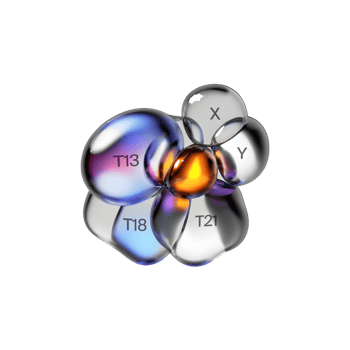
The test has very high accuracy for three specific conditions: trisomy 21, 18, and 13. These are also the conditions analyzed within Swedish healthcare, as they have strong scientific support and clear medical relevance.
Some providers offer more extensive tests that analyze many rare abnormalities. However, these can increase the risk of false positive results, which in turn may lead to unnecessary anxiety and more invasive follow-up procedures.
Not all NIPT tests are therefore equivalent. Testmottagningen offers an analysis in line with established healthcare practice, focusing on reliability and clinical value.
In summary, NIPT is not about testing as much as possible, but about obtaining relevant and reliable information that contributes to reassurance during pregnancy.
As more private providers offer increasingly comprehensive test panels, several experts and regional healthcare authorities have expressed concern. The question is not whether NIPT is good or not – but how the test is used and what it analyzes.
What is NIPT?
NIPT is a blood test taken from the pregnant woman. In the mother’s blood, there are small amounts of DNA from the placenta, which in most cases reflects the genetic makeup of the fetus.
The test is used to estimate the likelihood of certain chromosomal abnormalities in the fetus. It is important to emphasize that NIPT is a screening test, not a diagnostic test. This means that any abnormal result must always be followed up with additional examinations.
High accuracy – for the right conditions
For certain chromosomal abnormalities, NIPT has very high accuracy. This applies primarily to:
- Trisomy 21 (Down syndrome)
- Trisomy 18
- Trisomy 13
These are also the conditions analyzed within Swedish public healthcare and are in line with international guidelines. The reason for focusing solely on these conditions is clear: there is strong scientific evidence and clear clinical relevance that justify screening.
When more is not better
In recent years, some providers have begun offering so-called expanded NIPT tests, analyzing over 100 different chromosomal abnormalities.
However, several experts in obstetrics and clinical genetics have highlighted that this development presents significant challenges.
Many of the conditions included in these panels are extremely rare. At the same time, this affects the reliability of the test: even with advanced technology, the risk of false positive results increases when screening for rare abnormalities.
In practice, this can mean that a test result indicates a possible abnormality that is later not confirmed.
The consequences of this may include:
- increased anxiety during pregnancy
- the need for invasive follow-up tests
- a small but real increased risk of miscarriage
Against this background, several regions and experts have questioned the value of offering very broad test panels at present.
Not all NIPT tests are equal
It is easy to assume that all NIPT tests work in the same way – but this is not the case. The difference lies in what is analyzed and how the results should be interpreted.
With the NIPT-test offered by Testmottagningen – equivalent to the analysis used in public healthcare – you receive a result with high accuracy, strong scientific support, and a low risk of false positive findings.
Our approach: medical relevance and reassurance
At Testmottagningen, we have chosen to offer NIPT in line with established medical practice.
This means focusing on chromosomal abnormalities where:
- there is strong scientific evidence
- the test has high reliability
- the result has clear clinical significance
We have deliberately chosen not to include extensive panels with a large number of rare abnormalities, as these currently lack sufficient support for use in screening.
– For us, it is crucial that every test we offer has clear medical relevance and reliability that we can stand behind. In the case of NIPT, this means focusing on analyses where the scientific evidence is strong and where the results can truly contribute to reassurance – not unnecessary anxiety.
Erik Lind, Chief Medical Officer
For us, prenatal diagnostics is not about testing as much as possible – but about testing what provides meaningful and reliable information.
Transparency is essential
We are also clear about the limitations of the test.
- NIPT is a screening test
- An abnormal result is not a diagnosis
- Follow-up is always required for suspected findings
An important part of feeling reassured during pregnancy is understanding what the test can – and cannot – show.
Who may benefit from NIPT?
NIPT can be a valuable option for pregnant women who want more information about certain chromosomal abnormalities, particularly in situations where the risk is considered elevated.
At the same time, it is important that the decision to undergo testing is informed and well considered – not driven by anxiety or a feeling that “everything should be tested.”
Our goal: reassurance, not anxiety
The development of genetic diagnostics is advancing rapidly, and the possibilities are expanding. At the same time, greater responsibility is required in how the technology is used. Our goal is to contribute to a more informed and reassuring pregnancy – where every test offered is grounded in clear medical evidence. Ultimately, it is not about analyzing as much as possible, but about giving people access to the right information – at the right time.